Certificate vs. Master's Degree in Instructional Design
Jul 14, 2026
Certificate vs. Master's Degree in Instructional Design
By Dr. Robin Sargent · Founder, IDOL Academy · Last updated: January 30, 2025 · 10 min read
Quick answer
When weighing an instructional design certificate vs. a master's degree, certificates win on speed and cost, while master's degrees carry more academic weight. For most career changers, a certificate with a strong portfolio leads to employment faster and at lower total cost than a two-year graduate program.
In this article
Choosing between an instructional design certificate vs. a master's degree comes down to three things: how fast you need to move, how much you can spend, and what employers in your target market actually look for. Most people researching this question are career changers who already hold a bachelor's degree and want to know if they really need another two years of school to break into L&D. The short answer is: usually not. But the longer answer matters, so here it is.
What each credential actually signals to employers
A master's degree says you have deep theoretical grounding in learning science, instructional systems design, or educational technology. You spent 18 to 24 months (sometimes more) studying the research base behind how people learn. That matters for certain roles: academic positions, senior leadership in large L&D departments, and organizations where a graduate degree is a formal hiring filter.
A certificate says something different. It says you completed a focused, practical training program and you know how to do the work. The signal is competency over credential. That distinction is actually very well understood in the corporate L&D world, where hiring managers have watched plenty of master's degree graduates show up without knowing how to build a module in Articulate Rise or write a learning objective that connects to business outcomes.
Neither credential gets you hired on its own. What gets you hired is your portfolio. A certificate from a rigorous program paired with real work samples consistently outperforms a graduate degree with nothing to show for it. That is not a controversial statement in this industry. It is just what hiring managers say when you ask them directly.
Cost and time: a side-by-side comparison
Here is where the decision usually becomes clearest. The numbers are not close.
| Factor | Certificate Program | Master's Degree |
|---|---|---|
| Typical duration | 3 to 12 months | 18 to 48 months |
| Typical cost | $2,000 to $10,000 | $20,000 to $60,000+ |
| Can work full-time during | Usually yes | Possible but challenging |
| Portfolio built during program | Yes (in most quality programs) | Varies by program |
| Tool training included | Yes (in most quality programs) | Sometimes, often limited |
| Academic credit | No | Yes |
| Preferred for academic roles | No | Yes |
| Digital credentials / badges | Yes (in some programs) | Rarely |
Cost matters here because it affects your ROI math. If you spend $50,000 on a master's degree and it takes you two years to finish while working part-time, you are carrying a significant debt load before you ever land your first ID role. A certificate at $5,000 that gets you hired in under a year puts you in a completely different financial position.
According to the U.S. Bureau of Labor Statistics, the median annual wage for training and development specialists is around $63,000, with the field projected to grow 8% through 2032, faster than the national average. Enterprise instructional designer roles at technology companies frequently pay $80,000 to $120,000 or more, which is where most certificate graduates targeting corporate L&D land.
Want to see if instructional design is the right move for you?
IDOL Academy is a GNPEC-authorized 24-week program that combines 16 Credly-verified credentials, built-in AI training, and a real internship milestone, all at a price point below comparable bootcamps.
Try IDOL Academy FreeWhat do instructional design job postings actually require?
This is the most important section in this article. Not what sounds impressive, but what companies actually post when they are hiring.
Pull up a handful of instructional designer job postings at companies like Google or Amazon and you will see patterns:
- "Bachelor's degree required" appears in virtually every posting. "Master's degree required" is rare.
- "Portfolio required" or "please submit work samples" appears frequently.
- Tool-specific requirements are common: Articulate Storyline, Rise, Captivate, Lectora, or LMS administration.
- "Experience with ADDIE," "SAM model," or "adult learning principles" shows up regularly.
- AI literacy and familiarity with AI-assisted design tools is appearing in newer postings, and that trend is accelerating.
Notice what is absent from most postings: "Master's degree in instructional design required." When a graduate degree is listed, it is almost always "preferred" alongside equivalent work experience, not a hard gate. The exceptions exist in higher education faculty roles, senior director-level positions, and some research-focused L&D teams. Those are real, but they represent a small share of the market.
"Your portfolio is your degree in this field. Build it right and no one is asking about your transcript." — Dr. Robin Sargent
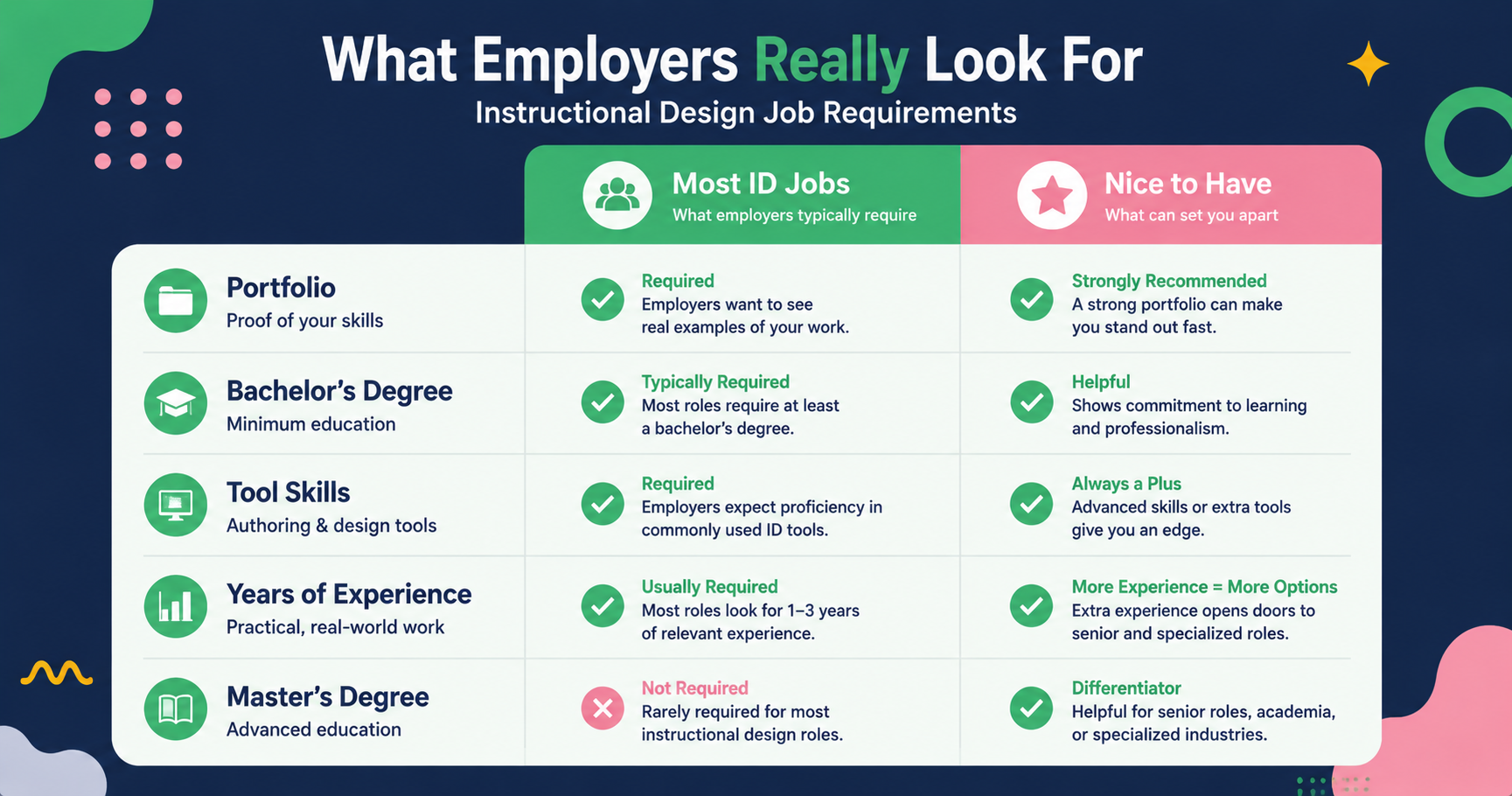 What employers actually ask for: portfolio and tool skills consistently outrank graduate degrees in corporate ID job postings.
When a master's degree is the right call
I am not going to tell you a master's degree is never worth it. That would be dishonest. There are real scenarios where it is the better path.
Academic career goals. If you want to teach instructional design at a university or work in higher education's center for teaching and learning, a master's degree (and often a doctorate) is the standard expectation. Period.
Senior leadership in large organizations. Some large enterprise L&D departments and government training agencies have formal credential requirements for director-level and above roles. A graduate degree can serve as a checkbox for promotion tracks in those environments.
Research-oriented roles. If you want to work in learning science research, human performance technology at a consulting firm, or policy-level education technology, a graduate degree signals the research grounding those roles require.
You genuinely want the academic experience. Some people want the immersion of a graduate program: the cohort, the research, the theoretical depth. That is a legitimate reason. If that experience is valuable to you, it is worth weighing the cost.
If any of those four apply to you, a master's degree deserves serious consideration. If none of them apply, the decision probably swings the other direction.
When a certificate is the right call
A certificate is the right call in most of the situations career changers actually find themselves in. Here is a clear list.
- You already have a bachelor's degree and you are pivoting into corporate L&D. You have the baseline academic credential employers want. You do not need another degree; you need proof of competency.
- You need to work while you train. Most certificate programs are designed for working adults. A master's program part-time stretches to 3 or 4 years and competes with a full-time job in a way that is genuinely brutal for many people.
- You want to build a portfolio during training. The best certificate programs build portfolio-ready work right into the curriculum. Many master's programs are heavy on theory papers and lighter on practical deliverables you can actually show an employer.
- Speed to employment matters. If you are a teacher leaving the classroom and need to replace income, six months beats two years in every possible way.
- You want to learn the tools employers actually use. Articulate 360, AI-assisted design, LMS platforms. Graduate programs sometimes cover these; certificate programs in this space usually lead with them.
- Your budget is real. A certificate at $5,000 does not leave you servicing debt during a career transition. $50,000 for a graduate degree does.
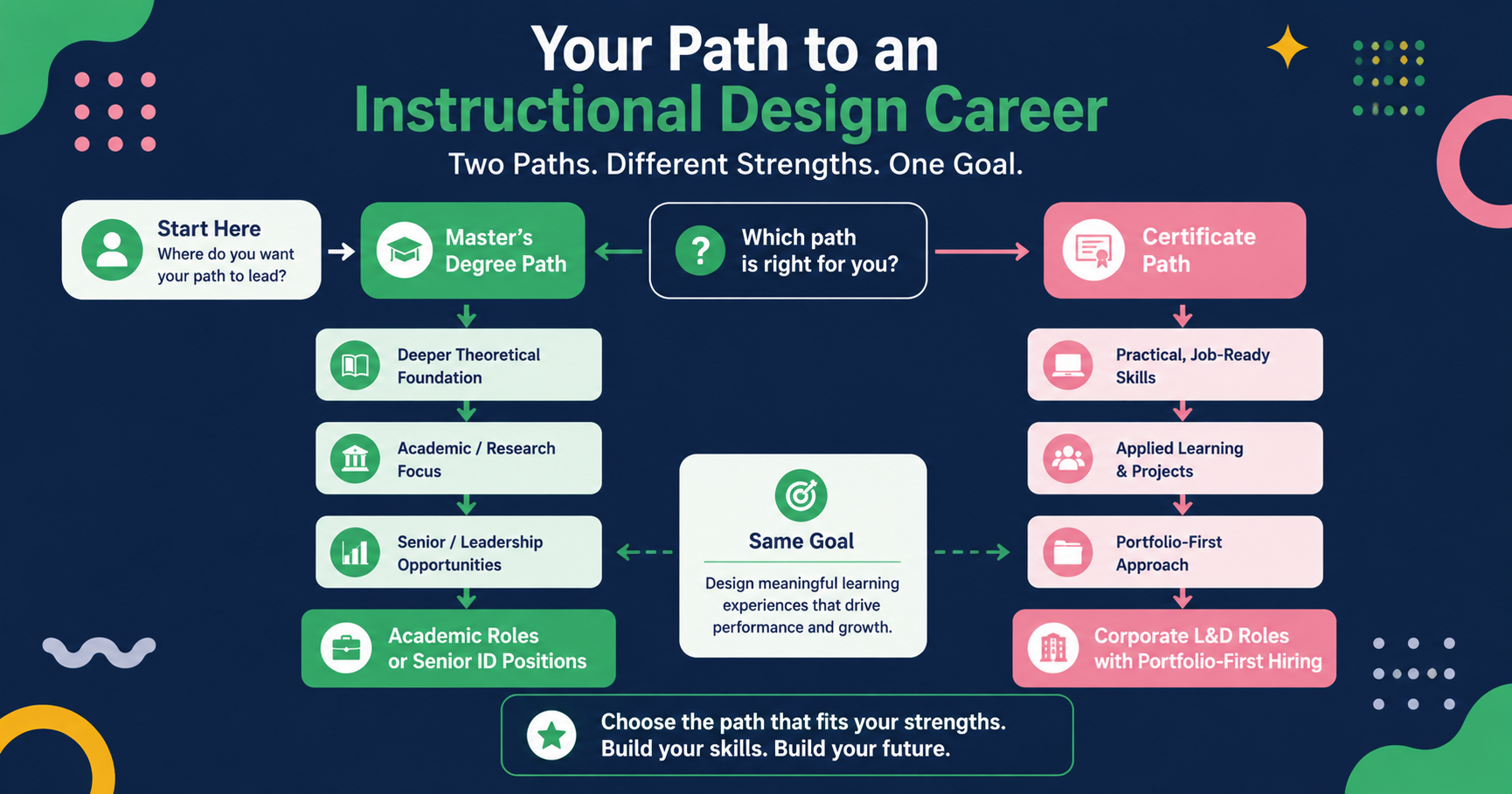 The decision often comes down to your target role, your timeline, and whether you can afford two more years of school.
What IDOL Academy's certificate includes
IDOL Academy is a 24-week vocational certificate program authorized by the Georgia Nonpublic Postsecondary Education Commission (GNPEC). That authorization means it meets Georgia's standards for private postsecondary institutions, which matters when you are evaluating whether a program is legitimate. It is not a degree-granting institution. It is a career-training program built specifically for the corporate L&D market.
Here is what the program delivers:
- CPTP credential: The Certified Professional in Training and Performance, earned at program completion.
- 16 Credly-verified digital badges: 8 core milestone badges, 5 tool-specific badges, and 3 AI badges through IDOLai (Level 1: AI Beginner, Level 2: AI User, Level 3: AI Creator).
- Internship milestone: 4 pathways available. Most completable without leaving your current job.
- Tool training: Included in the curriculum. Software licenses are the learner's responsibility.
- Pricing: $4,997 pay-in-full, or $697 per milestone across 8 milestones.
- Alumni network: 3,300+ graduates have gone through the program.
For context on how that stacks up against the broader market, a comparable instructional design bootcamp typically runs $8,000 to $15,000. IDOL Academy's price point sits below most of those while adding verified credentials and the AI training track that most programs do not have.
You can explore the IDOL Academy Knowledge Base for more detail on specific credential questions, or read about what GNPEC authorization means for your credential if you want to understand the regulatory side of how the program is classified.
Frequently Asked Questions
Is a master's degree required to become an instructional designer?
No. Most instructional design job postings list a bachelor's degree as the minimum requirement, and many employers prioritize portfolio work and tool proficiency over graduate credentials. A certificate combined with a strong portfolio is a fully viable path into the field.
How long does an instructional design certificate take compared to a master's degree?
Most instructional design certificates run between 3 and 12 months. A master's degree typically takes 18 to 24 months full-time, or 2 to 4 years part-time. If you need to transition careers quickly, a certificate gets you job-ready far faster.
Do instructional designers with a master's degree earn more than those with a certificate?
The U.S. Bureau of Labor Statistics reports a median annual wage for training and development specialists of around $63,000, but instructional design roles at technology and enterprise companies frequently pay $80,000 to $120,000+. Pay differences between credential types are less significant than differences in portfolio quality, tool skills, and the industry you work in.
What is the cost difference between an instructional design certificate and a master's degree?
An instructional design certificate program typically ranges from $2,000 to $10,000. A master's degree in instructional design or instructional technology averages $20,000 to $60,000 or more depending on the institution. For career changers who already hold a bachelor's degree, the cost-to-speed ratio usually favors a certificate.
Can I get an instructional design job without a degree in education or ID?
Yes. Many practicing instructional designers have undergraduate degrees in unrelated fields. What gets you hired is demonstrating that you can do the work: a portfolio with real samples, proficiency in tools like Articulate Storyline or Rise, and an understanding of learning design principles. A focused certificate program is specifically designed to build those things.
Is IDOL Academy a certificate program or a degree program?
IDOL Academy is a 24-week vocational certificate program authorized by the Georgia Nonpublic Postsecondary Education Commission (GNPEC). It is not a degree-granting institution. Graduates earn the CPTP (Certified Professional in Training and Performance) credential and 16 Credly-verified digital badges.
For most career changers, the instructional design certificate vs. master's degree question resolves quickly once you map your actual goals against what employers are asking for. Build your portfolio, learn the tools, earn verifiable credentials, and you are competitive in the market.
Want to see if instructional design is the right move for you?
IDOL Academy is a GNPEC-authorized 24-week program that combines 16 Credly-verified credentials, built-in AI training, and a real internship milestone, all at a price point below comparable bootcamps.
Try IDOL Academy Free```