Corporate Trainer to Instructional Designer: Is It a Natural Move?
Jul 09, 2026
Corporate Trainer to Instructional Designer: Is It a Natural Move?
By Dr. Robin Sargent · Founder, IDOL Academy · Last updated: January 30, 2025 · 10 min read
Quick answer
The corporate trainer to instructional designer move is one of the most natural pivots in L&D. You already understand learners, business context, and performance gaps. What you need to add is design methodology, authoring tool proficiency, and a portfolio of work that proves you can build, not just deliver.
In this article
- What skills do corporate trainers already have that transfer directly?
- What's actually different about instructional design work?
- Corporate trainer vs. instructional designer: how the roles compare
- What skills do you actually need to add?
- How to make the transition without starting over
- What the job market looks like for this transition
- Frequently asked questions
If you've spent years running training sessions and wondering who actually builds this stuff, you're already thinking like an instructional designer. The corporate trainer to instructional designer transition is genuinely one of the most natural pivots in learning and development. You know how adults learn, you understand the business, and you've seen firsthand what makes training land and what makes it fall flat. The gap between where you are and where you want to be is smaller than you think, but it is real, and it's worth understanding clearly before you make the move.
What skills do corporate trainers already have that transfer directly?
Corporate trainers often underestimate how much of what they do is already instructional design. You've been doing needs analysis every time you've looked at a performance problem and figured out whether training was actually the solution. You've written learning objectives, even if you didn't call them that. You've watched hundreds of people learn something new and noticed what clicks and what doesn't.
Here's what typically transfers without much translation:
- Adult learning principles. You've applied them live. Designers apply them in the build phase. Same knowledge, different timing.
- Business context. You know how the organization works, who the stakeholders are, and what "successful training" actually means to your VP. That context is rare and valuable in design work.
- Audience awareness. You've read rooms. You know the difference between a skeptical ops team and an eager new-hire cohort. That translates directly into designing for real people instead of hypothetical learners.
- Content expertise. If you've trained on a specific domain (compliance, sales, safety, software), you already understand the subject matter deeply. Instructional designers often spend weeks getting up to speed on content that you already know.
- Feedback and iteration. Good trainers adjust in real time. Good designers build in review cycles. The instinct for iteration is the same.
These aren't soft advantages. They are the things that take newer instructional designers, especially those coming straight from academic programs, a long time to develop. You already have them.
What's actually different about instructional design work?
The honest answer: the medium and the methodology are different, even when the goal is the same.
As a trainer, you are the delivery mechanism. Your presence, your energy, your ability to read the room, those are the tools. As a designer, you build something that works without you in the room. The course, the module, the job aid, the video. It has to be good enough to teach on its own.
That shift changes what you spend your time on:
- Instead of preparing to facilitate, you're writing storyboards and scripts.
- Instead of standing up and adjusting in real time, you're building in Articulate Storyline or Rise and iterating through review cycles with stakeholders.
- Instead of running the session, you're measuring whether the session (or module, or course) actually changed behavior after the fact.
- Instead of being the expert in the room, you're often working with subject matter experts to extract their knowledge and translate it into something a learner can actually use.
It's less performance and more architecture. Some trainers love that shift. Some miss the live energy. It's worth sitting with that honestly before you commit to the transition.
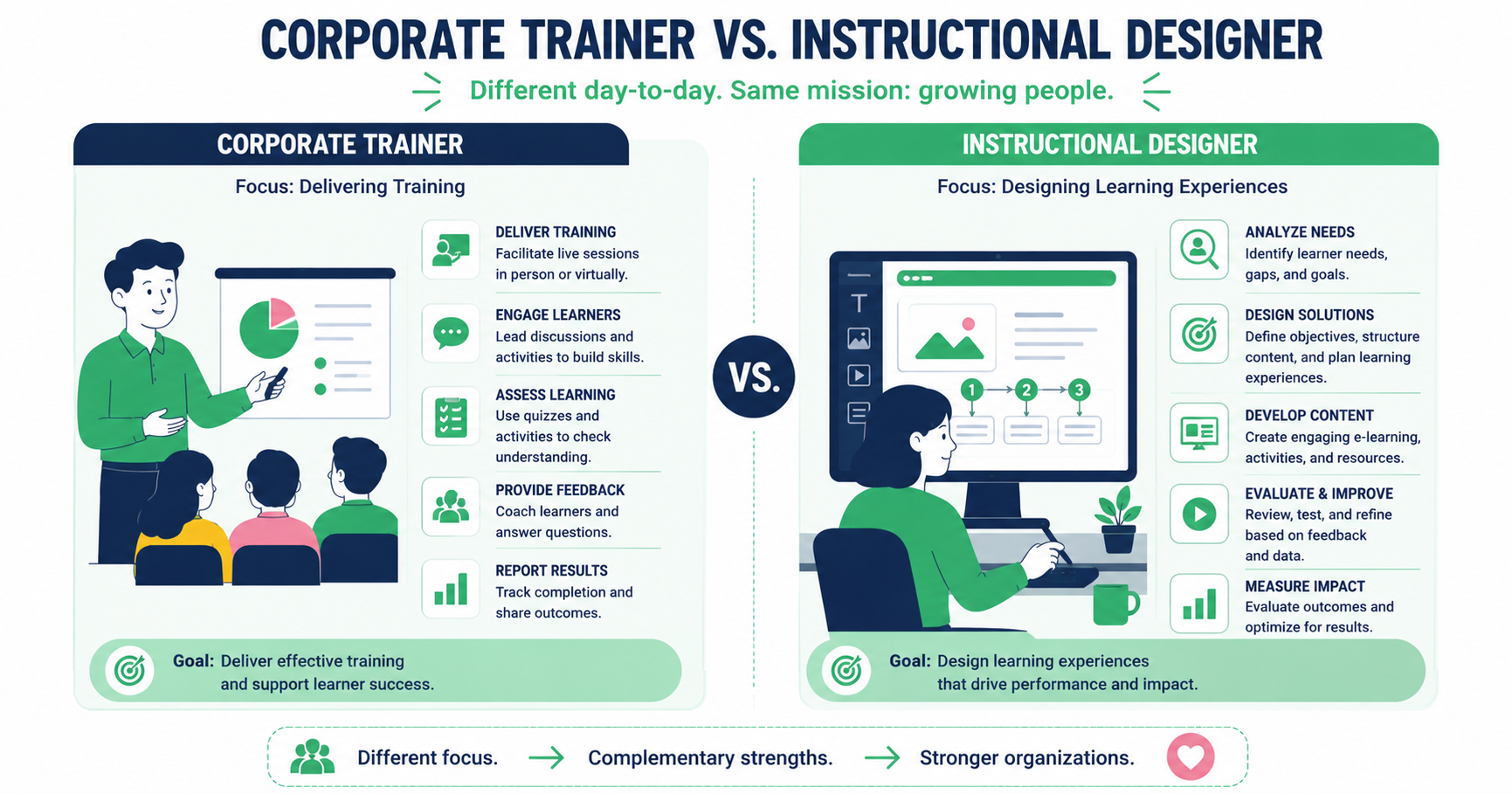 Trainers deliver. Designers build. Both roles require a deep understanding of how people learn.
Corporate trainer vs. instructional designer: how the roles compare
It helps to see the comparison laid out clearly, especially if you're trying to figure out which job descriptions to target and which skills to build first.
| Dimension | Corporate Trainer | Instructional Designer |
|---|---|---|
| Primary output | A facilitated learning experience | A designed learning artifact (course, module, job aid) |
| Core tools | Presentation software, LMS, facilitation materials | Articulate Storyline, Rise, Camtasia, Adobe tools, LMS |
| Work style | Live, high-energy, audience-facing | Project-based, iterative, collaborative with SMEs |
| Adult learning knowledge | Applied live in delivery | Applied in the build phase before delivery |
| Needs analysis | Often informal or inherited from others | Formal process: interviews, surveys, gap analysis |
| Typical salary range | $45,000 to $70,000 | $60,000 to $95,000+ |
| Remote work availability | Often requires on-site presence | Frequently fully remote |
| Portfolio required to hire | Rarely | Almost always |
Salary data for training and development roles comes from the U.S. Bureau of Labor Statistics, which projects 8% growth for training and development specialists through 2032, faster than average across all occupations. The design side of L&D consistently commands higher compensation than delivery-focused roles.
Want to see if instructional design is the right move for you?
IDOL Academy is a GNPEC-authorized 24-week program that combines 16 Credly-verified credentials, built-in AI training, and a real internship milestone, all at a price point below comparable bootcamps.
Try IDOL Academy FreeWhat skills do you actually need to add?
This is where people tend to either overestimate or underestimate the gap. Let's be specific.
Authoring tool proficiency
Most corporate instructional design jobs require hands-on experience with Articulate Storyline 360 or Articulate Rise, or both. If you've never built a branching scenario or a drag-and-drop interaction in Storyline, that's a real gap. It's learnable in weeks, not years, but you do need structured practice and you need projects in your portfolio that show you can use these tools at a professional level.
Design methodology
ADDIE (Analyze, Design, Develop, Implement, Evaluate) and SAM (Successive Approximation Model) are the two frameworks you'll see most often in job descriptions. You may have used a version of ADDIE informally for years without knowing what to call it. Getting formal fluency in both, and being able to talk through your design decisions in an interview, is non-negotiable.
Storyboarding and writing for eLearning
eLearning writing is its own skill set. It's not documentation writing. It's not training-manual writing. It's concise, scenario-based, and designed to move a learner through a decision or a concept without a facilitator there to fill in the gaps. This takes practice, and your portfolio needs to show you can do it.
A portfolio
This is the single biggest barrier for corporate trainers making this transition. You can have 10 years of training experience and still not get called back for an instructional design role if you don't have portfolio samples. Employers in L&D want to see your design work: a storyboard, an eLearning module, a course prototype, a job aid. They want evidence you can build, not just deliver. Building that portfolio during a structured program is the most efficient path.
"Your training experience is the story. Your portfolio is the proof. You need both to get hired." — Dr. Robin Sargent
How to make the transition without starting over
The most practical path for a corporate trainer is to build your design skills and portfolio while you're still in your current role. Here's why that works better than quitting first:
- You can apply what you're learning immediately. If you're building a course on safety compliance as part of a program, you can draw on real organizational context from your current job.
- You can pitch small design projects to your current employer. Many corporate trainers find that once they start showing design skills, their current organization starts pulling them into design work before they've even made the official switch.
- You maintain income stability while you build credentials. Instructional design transitions don't typically require a salary dip, but the job search takes time, and you want to search from a position of strength, not desperation.
- Your training experience becomes part of your designer story. In interviews, you can speak to the full learning lifecycle, from needs analysis through delivery through evaluation. That's a richer story than someone who's only ever been on the design side.
At IDOL Academy, the program is designed exactly for this. It's 24 weeks, self-paced with milestone gates, and all four internship pathways are built so you can complete them without leaving your job. You work on real projects. You build real portfolio pieces. You earn credentials that are verifiable on Credly. By the time you're ready to apply for instructional design roles, you have 16 badges and a portfolio ready to show.
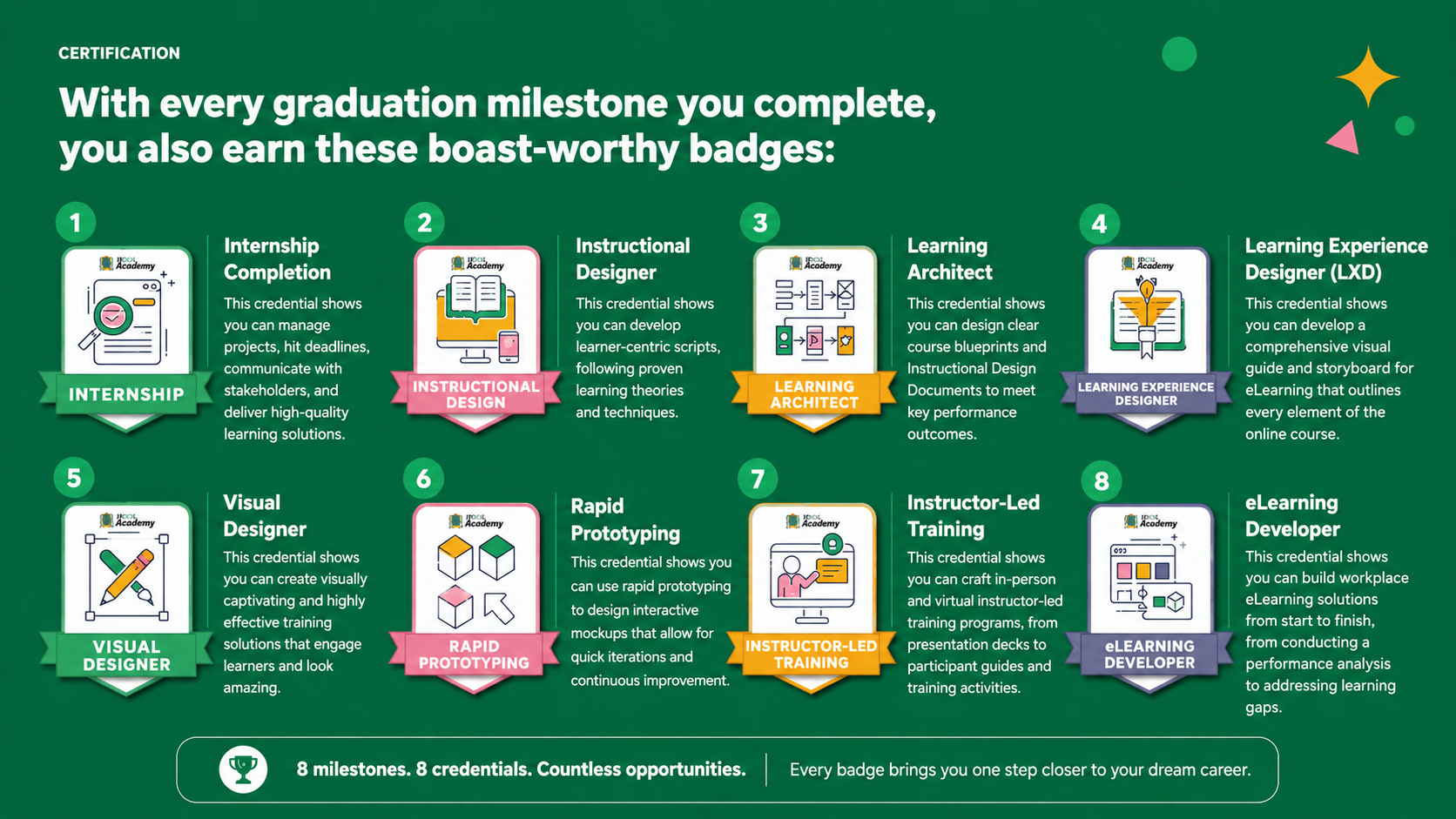 IDOL Academy's 8 milestone structure lets you build credentials and portfolio pieces in parallel, without pausing your career.
What the job market looks like for this transition
The demand for instructional designers is real and steady. Companies like Google, Amazon, Microsoft, Apple, Salesforce, and Nike all hire instructional designers regularly, and many of their job descriptions explicitly list training or L&D experience as a qualifying background. You're not pivoting into an obscure field. You're moving one step upstream in the same industry.
What the job market rewards in this transition:
- Portfolio over degree. Across L&D job postings, portfolio quality is cited more often than degree level as a hiring factor. A master's in instructional design is not required to compete.
- Tool certifications. Articulate certification, Adobe certifications, and verified credentials from platforms like Credly signal you've done the work, not just read about it.
- AI literacy. This is becoming a genuine differentiator. Employers are increasingly asking about AI tools in the design process. Having formal AI training, such as the IDOLai curriculum included in IDOL Academy's tuition, positions you ahead of most applicants.
- Domain expertise. If you've trained in healthcare, financial services, manufacturing, or technology, that domain knowledge is a real asset. Many companies prefer instructional designers who already understand the business context.
One honest note: the job market rewards specificity. "Instructional designer with corporate training background in pharmaceutical compliance" will outperform "instructional designer with various training experience" in a targeted search. As you make the transition, think about where your training experience is most concentrated and lean into that.
If you want to understand how instructional designer salaries break down across industries and experience levels, the IDOL Academy Knowledge Base has a full article on that. It's worth reading before you decide where to target your search.
Frequently Asked Questions
Is corporate training experience enough to get hired as an instructional designer?
Experience alone rarely lands the job. Employers want to see a portfolio of actual design work: storyboards, eLearning modules, job aids, and course prototypes. Corporate training experience gives you a head start on understanding learner needs, but you still need to build and show the design artifacts.
What skills do corporate trainers already have that transfer to instructional design?
Corporate trainers typically bring strong facilitation skills, experience identifying performance gaps, an understanding of adult learners, and familiarity with the business context of training. These are genuinely valuable in instructional design. What most trainers need to add is proficiency with authoring tools like Articulate Storyline, formal design methodology like ADDIE or SAM, and a portfolio of work.
Do I need a master's degree to become an instructional designer if I'm already a corporate trainer?
No. Many instructional designers working in corporate L&D do not have master's degrees in instructional design. A targeted certificate program that builds your portfolio and credentials can be more effective than a two-year degree, especially if you already have a bachelor's and professional experience. Employers in L&D consistently cite portfolio quality over degree level.
How long does it take to transition from corporate trainer to instructional designer?
Most people making this transition land their first instructional design role within 6 to 12 months of starting a structured program. The timeline depends on how quickly you build your portfolio, whether you can apply skills in your current job, and how actively you pursue the transition. A 24-week certificate program gives you a realistic runway.
What does an instructional designer do that a corporate trainer doesn't?
Instructional designers build the training before it gets delivered. They conduct needs analyses, write learning objectives, create storyboards, develop eLearning modules in authoring tools, design assessments, and evaluate whether training actually changed behavior. Trainers typically deliver content someone else designed. Designers are the architects; trainers are often the contractors who execute on-site.
Can I transition from corporate trainer to instructional designer without leaving my current job?
Yes, and most people who make this transition do exactly that. IDOL Academy's program is self-paced with milestone gates, and all four internship pathways are designed to be completable without leaving your current position. Building your portfolio while still employed also gives you real organizational context to draw on.
The corporate trainer to instructional designer move is one of the most well-positioned pivots in L&D, and if you've been in training long enough to ask this question, you're probably closer than you realize. The main thing standing between where you are now and an instructional design role is a portfolio and the credentials to back it up.
Want to see if instructional design is the right move for you?
IDOL Academy is a GNPEC-authorized 24-week program that combines 16 Credly-verified credentials, built-in AI training, and a real internship milestone, all at a price point below comparable bootcamps.
Try IDOL Academy Free