How Long Does It Take to Become an Instructional Designer?
Jul 12, 2026
How Long Does It Take to Become an Instructional Designer?
By Dr. Robin Sargent · Founder, IDOL Academy · Last updated: May 7, 2026 · 9 min read
Quick answer
How long does it take to become an instructional designer? For most career changers, six to twelve months of focused, structured work is enough to build a portfolio, earn verifiable credentials, and land a first paid role. The IDOL Academy 24-week program is built around that timeline.
In this article
How long does it take to become an instructional designer depends almost entirely on the path you pick. Through a structured program with a real portfolio and a verifiable credential, six months is realistic. Through a master's degree, two to three years. Through self-teaching, often longer than that with no guaranteed proof at the end. The fastest paid placements come from the path with the most feedback.
The honest timeline by path
There is no single answer because there is no single path. What matters is what you produce by the end and whether anyone can verify it.
- Structured certificate program: 6 to 9 months. A program like IDOL Academy is built for 24 weeks of milestone-paced work. Most graduates begin applying for roles before they finish.
- Master's in Instructional Design: 18 to 36 months, plus thesis or capstone. Heavy on theory, lighter on portfolio.
- Self-taught path: 18 months to several years, with high variance. The bottleneck is not knowledge. It is feedback and a credential someone can verify.
- Bootcamp: 8 to 16 weeks. Faster, but typically narrower in scope. Most do not include a real internship milestone or state authorization.
For broader context on what an ID actually does day to day, see What Do Instructional Designers Actually Do All Day?. The work is well-defined enough that the timeline becomes a function of feedback density, not of how long you watch videos.
Why 24 weeks is the right benchmark
24 weeks is roughly six months. It is long enough to build something real and short enough to keep momentum. It maps cleanly to eight milestone gates, with three weeks per milestone on a self-paced calendar.
At IDOL Academy, the 24-week program produces:
- A portfolio with 8 to 10 real artifacts a hiring manager can review.
- 16 Credly-verified digital badges (8 core milestone badges, 5 tool badges, 3 IDOLai AI badges).
- The CPTP credential (Certified Professional in Training and Performance).
- A completed internship milestone with documented work.
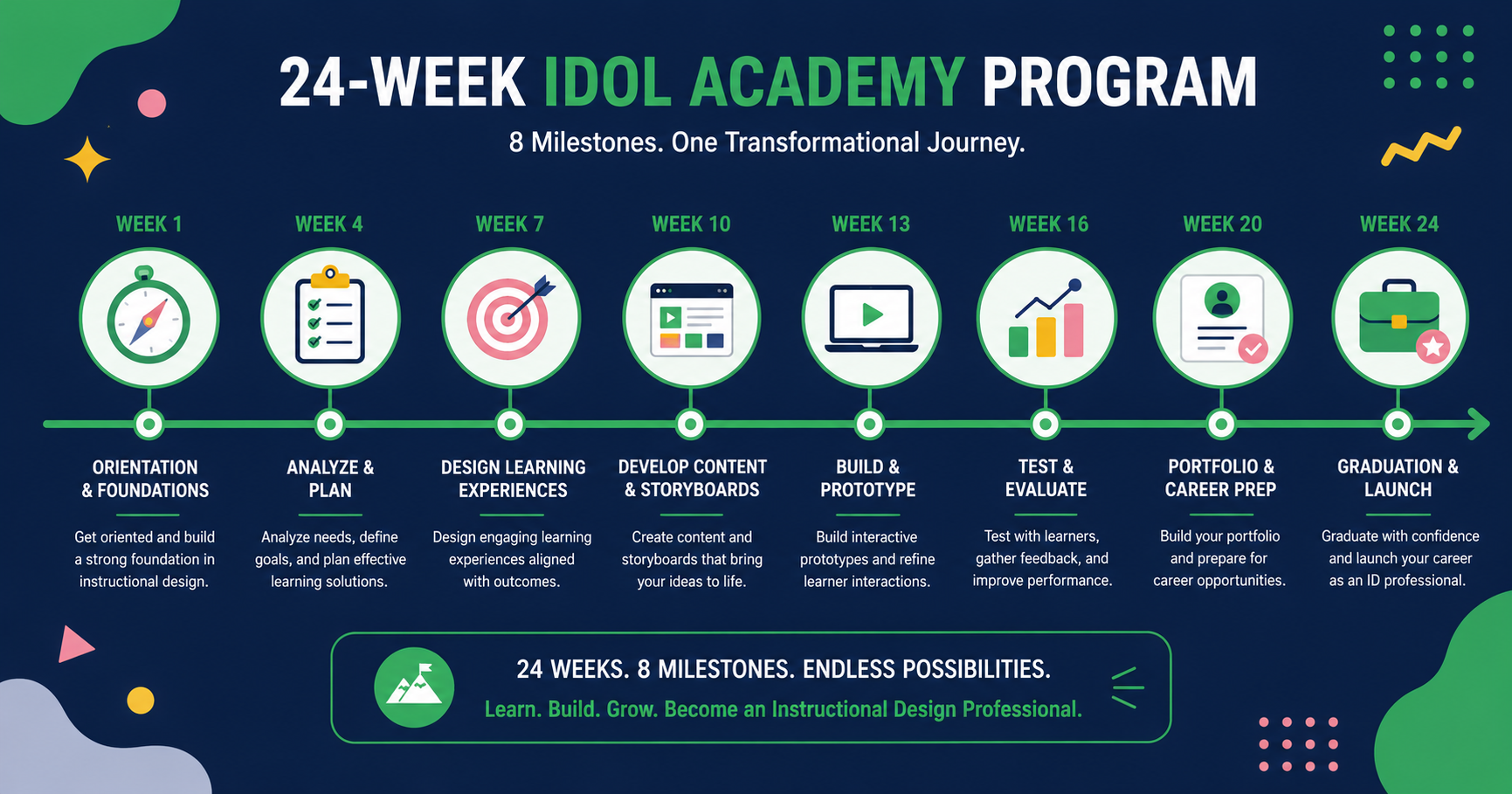 Eight rubric-graded milestones spread across 24 weeks.
The reason that timeline holds for working professionals is that the program is self-paced with Friday milestone gates. You can move faster than 24 weeks if life allows. You cannot pretend to finish a milestone. The rubric is the gate, not the calendar.
IDOL Academy is authorized by the Georgia Nonpublic Postsecondary Education Commission (GNPEC), which sets standards for vocational programs. That state authorization is part of why the 24-week structure is the right length: too short and the rubric stops being defensible, too long and the program turns into an academic degree without the title.
Want to see if instructional design is the right move for you?
IDOL Academy is a GNPEC-authorized 24-week program that combines 16 Credly-verified credentials, built-in AI training, and a real internship milestone, all at a price point below comparable bootcamps.
Try IDOL Academy FreeWhat slows people down
The timeline is rarely about the content. It is about the obstacles people put in front of themselves.
Researching instead of building
The most common stall pattern is months of reading articles, joining webinars, and bookmarking tools without producing a single artifact. The field looks complicated from the outside. It only stops looking complicated once you build something against a rubric.
Perfectionism on the first blueprint
Most career changers want their first piece to look like the last piece a 10-year veteran would produce. That is not how the field works. Your skills grow ten times faster if you design 20 imperfect blueprints than if you spend a year on one perfect course.
"It's not possible to improve what doesn't exist." — Dr. Robin Sargent
No feedback loop
The reason self-taught paths take years is the absence of someone whose job it is to tell you whether your work is hireable yet. A rubric-graded milestone is faster than another six months of guessing. This is the central reason a structured program produces working IDs in months, not years.
A credential that does not verify
Plenty of platforms hand out completion certificates. A hiring manager cannot verify those with one click. Credly-issued badges back any claim with the issuing organization, the date, and the criteria for earning them. That difference often determines whether a candidate moves to an interview or gets passed over silently.
What speeds people up
The career changers who hit the field fastest share the same handful of habits.
- They pick a path with structure. A milestone-based program creates external accountability. A book on a nightstand does not.
- They start applying before graduation. Most IDOL Academy graduates begin interviewing in milestone five or six. The portfolio does not need every badge filled in to start conversations.
- They use their existing job as the internship. Most working professionals can complete the internship milestone inside their current role rather than waiting for a separate placement.
- They build for a specific employer or industry. A portfolio aimed at healthcare training looks different from one aimed at SaaS. Specificity moves people through hiring funnels faster.
- They stop hiding in research. The first blueprint is the unblock. Everything afterward is iteration.
For teachers, the ramp is even shorter because the underlying skills already exist. See How Teachers Transition into Instructional Design for the specific translation work that condenses the timeline further.
Timeline comparison: certificate, master's, self-taught
Here is how the three most common paths compare on time, cost, and what you walk away with.
| Path | Typical timeline | Typical cost | What you produce |
|---|---|---|---|
| IDOL Academy certificate | 24 weeks | $4,997 pay-in-full or $697 per milestone | Portfolio, 16 Credly badges, CPTP, completed internship |
| Master's in Instructional Design | 18 to 36 months | $20,000 to $60,000 | Degree, theory background, often light portfolio |
| Self-taught | 18 months to several years | Variable, often $500 to $3,000 in tools and courses | Portfolio of varying quality, no verifiable credential |
For a deeper look at the certificate vs degree decision, see Certificate vs. Master's Degree in Instructional Design. The U.S. Bureau of Labor Statistics classifies most ID work under Training and Development Specialists, a category projected to grow faster than the average occupation through 2032, which puts the time investment in context against the trajectory of the field.
What about the first paid role?
Becoming an instructional designer and getting paid as one are connected questions but not the same question. The credential and portfolio create the ability to compete for roles. The job search is its own timeline.
For most career changers in the IDOL Academy community, the timing pattern looks like this: the program runs about 24 weeks, applications begin during milestones five and six, and first paid roles often arrive in the two to four months after graduation. Some land before graduation. Some take longer because they are aiming at narrow industries or named employers. The full IDOL Academy Knowledge Base covers the job search side of this in more detail.
No reputable program guarantees employment outcomes, and IDOL Academy does not either. What the program does guarantee is the structure: 24 weeks, eight rubric-graded milestones, 16 verifiable credentials, and a portfolio that can survive a five-second hiring manager scan.
Frequently asked questions
How long does it take to become an instructional designer?
Most career changers can become a working instructional designer in six to twelve months of focused, structured work. The IDOL Academy program runs 24 weeks, which is roughly six months, and most graduates begin applying for roles before they finish. Self-taught paths typically take two to three years because they lack feedback loops and a verifiable credential.
Can you become an instructional designer in 6 months?
Yes, with structured training. The IDOL Academy program is designed to take 24 weeks, which is just under six months. That includes building a portfolio, earning 16 Credly-verified badges, and completing a real internship milestone. The path is faster than a master's degree by a wide margin and produces stronger portfolio evidence.
Do you need a master's degree to become an instructional designer?
No. Most working instructional designers do not have a master's in instructional design. Hiring managers prioritize a strong portfolio and verifiable credentials over an academic degree. A 24-week certificate program with rubric-graded milestones produces the kind of proof employers actually verify.
How long does it take if you are already a teacher?
Teachers typically move faster than career changers from unrelated fields because the underlying competencies overlap. Curriculum design, assessment, learner engagement, and differentiation are all transferable. The work is in translating those skills into corporate vocabulary and building portfolio artifacts in formats the L&D field uses.
Is becoming an instructional designer worth the time?
Instructional design salaries in the United States are generally well above the national median, and the field continues to expand because of digital learning growth and the rise of AI-supported training. Most IDOL Academy graduates report meaningful salary increases over their previous role. The time investment is small relative to a master's degree and the income trajectory.
Can you become an instructional designer while working full time?
Yes. Most IDOL Academy graduates complete the 24-week program while employed full time. The program is self-paced with Friday milestone gates. The internship milestone has four pathways, and most can be completed inside an existing role rather than requiring a separate placement.
Want to see if instructional design is the right move for you?
IDOL Academy is a GNPEC-authorized 24-week program that combines 16 Credly-verified credentials, built-in AI training, and a real internship milestone, all at a price point below comparable bootcamps.
Try IDOL Academy Free