How to Become an Instructional Designer
Jul 01, 2026
How to Become an Instructional Designer
By Dr. Robin Sargent · Founder, IDOL Academy · 10 min read
Quick answer
To become an instructional designer, you need transferable skills, hands-on tool training, a portfolio of real sample projects, and a recognized credential. Most career changers complete a structured certificate program in 24 weeks and land their first ID role within a year, no prior ID degree required.
In this article
You don't need a degree in instructional design to become one. Most people who successfully make this transition come from teaching, corporate training, HR, or another field entirely. Knowing how to become an instructional designer means understanding what the work actually involves, which skills you already have, what gaps you need to close, and how to prove your readiness to a hiring manager who has never heard your name before.
What does an instructional designer actually do?
The job title varies: instructional designer, learning experience designer, eLearning developer, curriculum designer, L&D specialist. The core work is the same across all of them. You figure out why people aren't performing the way they should. Then you design something to fix it.
On any given week, an instructional designer might:
- Interview a subject matter expert to extract what they know so it can be taught to others
- Write learning objectives that connect to a measurable business outcome
- Build an interactive eLearning course in Articulate Storyline or Rise
- Create a facilitator guide for an instructor-led training session
- Present a design proposal to a department head or project stakeholder
- Review evaluation data to see whether the training actually changed behavior
The setting varies too. You might work inside a company's internal learning and development team. You might work for a consulting firm that serves multiple clients. You might freelance. The Bureau of Labor Statistics tracks this occupation under "instructional coordinators" and reported a median annual wage of $77,670 as of May 2023, with employment projected to grow 2 percent through 2032. That's a stable field with real earning potential, not a crowded market with shrinking demand.
You can verify the latest employment data at bls.gov/ooh/education-training-and-library/instructional-coordinators.
What skills and background do you need?
Here's the honest answer: you probably already have more than you think. The question is whether you can translate what you have into what employers recognize.
The four most common backgrounds that feed into instructional design are:
| Your background | Skills that transfer | Gaps to close |
|---|---|---|
| K-12 or higher education teacher | Curriculum writing, learning objectives, classroom management, differentiation | Corporate L&D context, authoring tools, adult learning theory application |
| Corporate trainer | Facilitation, audience awareness, content delivery, business context | Formal design process (ADDIE/SAM), eLearning development, portfolio |
| HR professional | Organizational context, compliance knowledge, stakeholder navigation | Design methodology, tool proficiency, evaluation frameworks |
| Adjacent field (marketing, writing, healthcare, etc.) | Subject matter expertise, communication skills, audience thinking | Full design process, tools, ID-specific vocabulary and credentials |
No matter where you're coming from, the gaps are learnable. None of them require a two-year degree. They require structured practice, the right tools, and a portfolio that shows you can do the work.
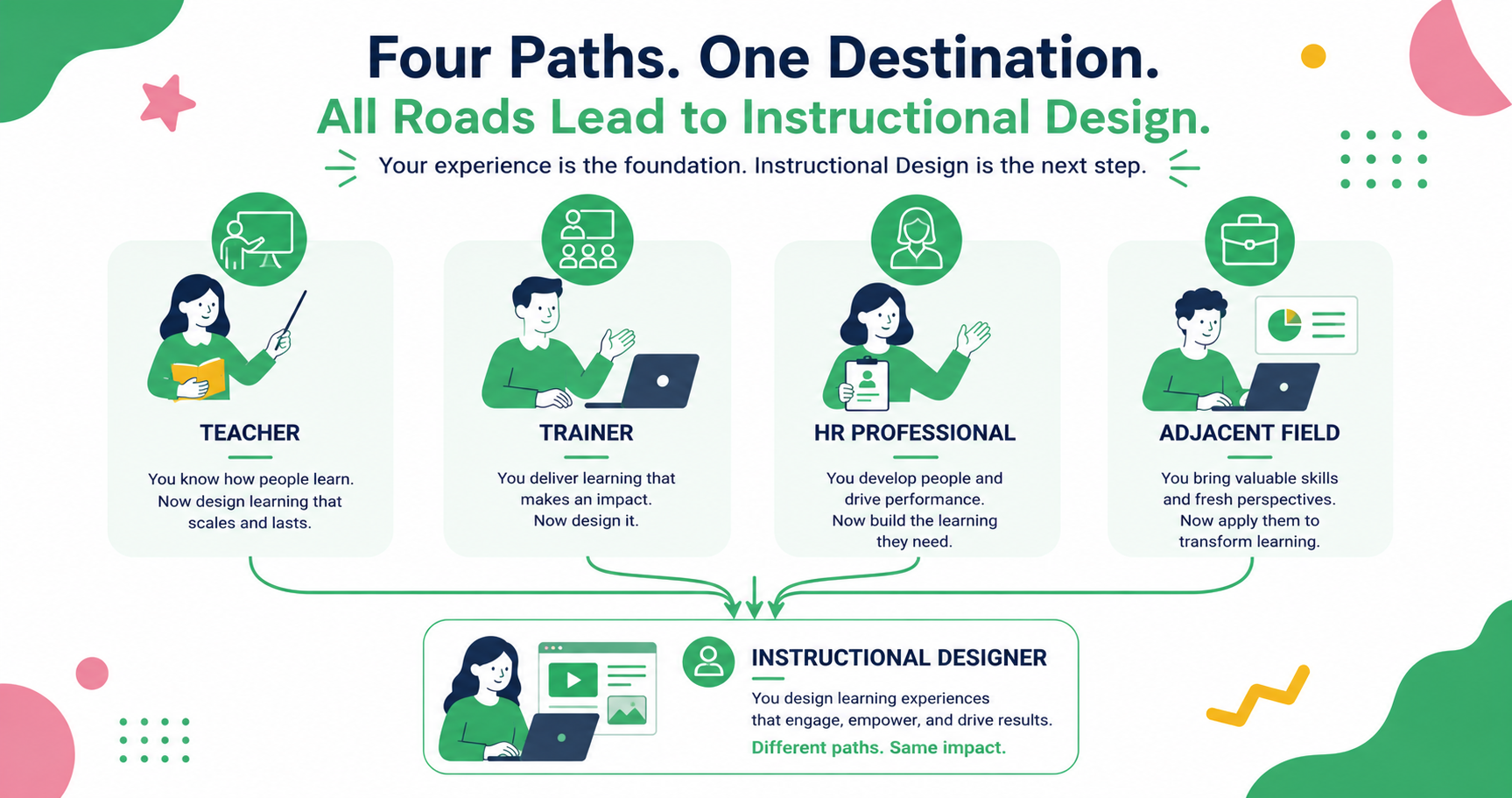 The four most common entry points into instructional design, and what each one already brings to the table.
What credential path should you choose?
This is where most people get stuck. Three realistic options exist: a master's degree, a certificate program, or self-directed learning. Each has a real case for it. Here's how they compare honestly.
| Path | Time | Cost | Portfolio output | Best for |
|---|---|---|---|---|
| Master's degree (ID or Ed Tech) | 2+ years | $20,000–$60,000+ | Varies by program, often limited | Academic or senior roles; those who want depth over speed |
| Certificate program (e.g., IDOL Academy) | 24 weeks | $4,997 or $697/milestone | Portfolio built milestone by milestone, internship included | Career changers who need speed, structure, and proof of skills |
| Self-directed (YouTube, free courses, books) | Open-ended | Low or free | Only what you build on your own | People who already have adjacent ID experience and just need specific skill gaps filled |
For most career changers, the certificate path closes the gap the fastest with the least financial risk. IDOL Academy, for example, is authorized by the Georgia Nonpublic Postsecondary Education Commission (GNPEC), which means the program has passed external review, not just self-reported quality claims. That authorization matters when you're listing credentials on a resume.
"A portfolio with three strong pieces beats a resume with ten years of adjacent experience every single time." — Dr. Robin Sargent
Want to see if instructional design is the right move for you?
IDOL Academy is a GNPEC-authorized 24-week program that combines 16 Credly-verified credentials, built-in AI training, and a real internship milestone, all at a price point below comparable bootcamps.
Try IDOL Academy FreeWhat tools do instructional designers use?
Tool proficiency is non-negotiable. You can talk about design theory all day long, but if you can't open Articulate Storyline and build a branching scenario, you won't get hired. Here's what the market actually uses:
Authoring tools
- Articulate Storyline 360: the industry standard for interactive eLearning. Most job postings list it by name.
- Articulate Rise: web-based, responsive course builder. Faster to build, less interactive than Storyline.
- Adobe Captivate: less common than Articulate but still used in large enterprise environments.
Visual and design tools
- Canva: the go-to for fast visual design when you don't have a dedicated graphic designer.
- Adobe Illustrator / Photoshop: useful at more senior levels, less expected at entry level.
- PowerPoint and Google Slides: still widely used for facilitator decks and storyboards.
AI tools for content development
This is not optional anymore. Employers expect instructional designers to know how to use AI to accelerate content development, not replace their thinking, but speed up the work. That means using AI for script drafts, scenario generation, quiz writing, and voiceover scripting. Programs that don't include AI training are already behind.
IDOL Academy includes IDOLai, a three-level AI certification built directly into the program at no additional cost. You learn to use AI tools as a practitioner, not just as a concept.
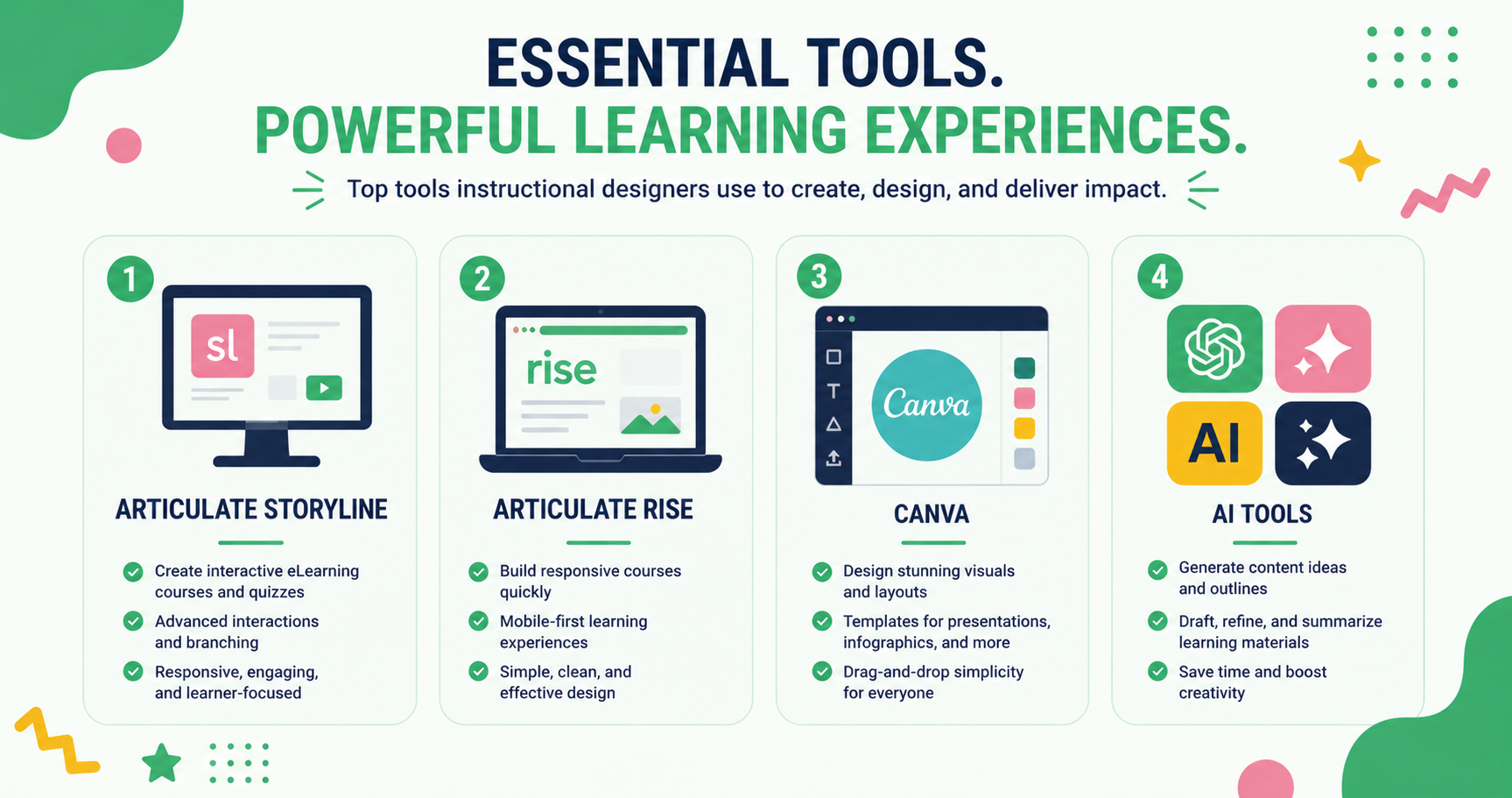 The tools most instructional designers use daily. Knowing them before your interview matters.
How do you build a portfolio with no experience?
This is the question everyone asks and the one most programs answer badly. "Just build sample projects" is not a helpful answer when you don't know what good looks like yet.
Here is what actually works:
1. Build from program milestones
The best certificate programs are structured so that every assignment produces something portfolio-ready. In IDOL Academy, each of the 8 milestones produces a deliverable you can show to a hiring manager. By the time you're done, you have a portfolio, not just a certificate.
2. Redesign something that already exists badly
Find a real piece of training that is bad, a confusing onboarding PDF, a dry compliance video, an overcrowded PowerPoint deck, and redesign it. Show the before and after. Explain your design decisions. This demonstrates your process, not just your output.
3. Complete a real internship milestone
IDOL Academy includes an internship milestone with four pathways. Most people complete it without leaving their current job. You might design something for a nonprofit, a small business, a local organization, or even your current employer. Real-world context closes the credibility gap that sample projects can't fully address.
4. Document your design process, not just the finished product
Hiring managers want to see how you think. Include your needs analysis, your storyboard, your first draft, and how feedback changed the final version. A portfolio case study that walks through your whole process is worth more than five polished final deliverables with no context.
What does the job market look like for new instructional designers?
The demand is real, but you need to know where to look and how to position yourself.
Industries that hire instructional designers at high volume include:
- Technology companies (look at Google Careers and Amazon Jobs for current postings)
- Healthcare and pharmaceutical organizations
- Financial services and insurance
- Government and military
- Higher education and professional associations
- Consulting firms and L&D agencies
Remote work is common in this field, which expands your search nationally rather than limiting it to local postings. That matters if you're in a smaller market.
Entry-level titles to search include: instructional designer, eLearning developer, learning experience designer, curriculum developer, and L&D specialist. Don't hold out for a title that matches exactly. Look for the responsibilities in the job description and match your portfolio to what they're asking for.
IDOL Academy's 3,300+ alumni work across all of these industries. The Brandon Hall Award for Best Training Program for L&D Professionals reflects the outcomes those alumni have produced, not just the program's design.
For a full overview of the skills hiring managers look for and how to demonstrate them, visit the IDOL Academy Knowledge Base.
Frequently Asked Questions
Do I need a degree to become an instructional designer?
No. Many instructional designers enter the field without a degree specifically in instructional design. Employers care more about your portfolio, your ability to apply a design process, and the tools you know than the letters after your name. A certificate program combined with a strong portfolio will get you further than a master's degree with no real work to show.
How long does it take to become an instructional designer?
It depends on the path you choose. A focused certificate program like IDOL Academy takes 24 weeks. A master's degree takes two years or more. Some people self-teach using free resources but find the lack of structure and credentials makes job searching harder. Most career changers who complete a structured program land their first ID role within 6 to 12 months of finishing.
What skills do I need to become an instructional designer?
Core skills include applying an instructional design model like ADDIE or SAM, writing clear learning objectives, building courses in an authoring tool like Articulate Storyline or Rise, creating visual assets, and understanding how adults learn. Increasingly, employers also want familiarity with AI tools for content development. You build all of these through practice, not just reading about them.
Can teachers become instructional designers?
Yes, and many of the best instructional designers came from teaching. You already understand how learning works, how to write objectives, and how to manage a room full of people with different needs. The pivot requires learning corporate L&D context, authoring tools, and how to design for digital delivery, but the foundational skills transfer directly.
What does an instructional designer actually do at work?
Instructional designers analyze performance gaps, design training or learning experiences to close those gaps, build courses and materials using authoring tools, collaborate with subject matter experts, and evaluate whether the training worked. In a corporate setting, that might mean building onboarding for 500 new hires or designing a compliance course for a regulated industry.
How much do instructional designers earn?
According to the U.S. Bureau of Labor Statistics, the median annual wage for instructional designers and coordinators was $77,670 as of May 2023. Salaries vary widely based on industry, location, and experience. Corporate instructional designers at tech companies often earn significantly above that median, especially with a strong portfolio and recognized credentials.
If you want to dig deeper into salary ranges by experience level and industry, read Instructional Designer Salary: What to Expect at Every Stage of Your Career.
Becoming an instructional designer is a concrete, achievable goal when you follow a structured path: know what the work involves, assess your starting point honestly, close your gaps with targeted training and tool practice, build a portfolio that proves your skills, and get into the job market with credentials a hiring manager can verify.
Want to see if instructional design is the right move for you?
IDOL Academy is a GNPEC-authorized 24-week program that combines 16 Credly-verified credentials, built-in AI training, and a real internship milestone, all at a price point below comparable bootcamps.
Try IDOL Academy Free```