Instructional Design for HR Professionals
Jul 08, 2026
Instructional Design for HR Professionals
By Dr. Robin Sargent · Founder, IDOL Academy · 10 min read
Quick answer
Instructional design for HR professionals is one of the most natural career pivots in the field. Your existing skills in needs assessment, compliance, and employee development transfer directly. What you need to add is formal ID methodology, authoring tool proficiency, and a portfolio that proves you can build training, not just manage it.
In this article
- Why HR experience is a real advantage in instructional design
- What skills you already have and what you still need to build
- How instructional design salaries compare to HR roles
- The difference between HR training coordination and ID
- How to make the transition without starting over
- Frequently asked questions
If you work in HR and you've spent years onboarding employees, managing compliance training, or rolling out leadership development programs, you're closer to instructional design for HR professionals than you might think. The pivot isn't about starting over. It's about naming what you already do, filling the specific gaps, and building the portfolio evidence that proves you can design training from scratch.
Why HR experience is a real advantage in instructional design
Most people who come into instructional design from outside HR have to learn what HR professionals already live: how organizations actually function, why people resist change, what compliance really means, and how training connects to business outcomes. You already know all of that.
You've sat in meetings where a department head explains a performance problem and expects a training solution in 30 days. You've coordinated vendor-led workshops and watched half the room disengage by 10 a.m. You've written onboarding documentation that was technically complete and practically useless. Those experiences aren't just context. They're the raw material for becoming a better instructional designer than someone who learned ID in a vacuum.
Here's what that means practically. A new ID who came straight from a graduate program has to spend their first two years learning organizational dynamics on the job. You already have those two years banked. That makes you faster to value in a corporate L&D role, and it makes your portfolio work more credible because you understand the real constraints behind every project.
"The instructional designers who grow the fastest in corporate L&D are the ones who already understand the business. HR professionals walk in with that on day one." — Dr. Robin Sargent
Companies like Amazon, Google, and Microsoft post instructional design roles that specifically list "experience working with HR or people development teams" as a qualification. Your background isn't a liability you need to apologize for. It's a differentiator you should lead with.
What skills you already have and what you still need to build
Let's be specific. Not everything transfers, and being honest about the gaps is how you close them efficiently. Here's a clear breakdown:
| Skill area | HR background gives you | What you still need to build |
|---|---|---|
| Needs analysis | Experience identifying performance gaps and compliance requirements | Formal ADDIE or SAM methodology; front-end analysis documentation |
| Stakeholder management | Strong. You've negotiated with department heads and executives. | SME interview techniques specific to course development |
| Content development | Writing policies, job aids, onboarding guides | Storyboarding, script writing, course architecture in authoring tools |
| Authoring tools | Possibly basic. HRIS experience helps with tech comfort level. | Articulate Storyline, Rise, Camtasia, Adobe tools at a production level |
| Adult learning theory | Informal exposure through training coordination | Formal grounding in Bloom's Taxonomy, cognitive load, spaced practice |
| Evaluation | Kirkpatrick Level 1 (reaction surveys) likely familiar | Levels 2-4 measurement design; data interpretation for L&D decisions |
| Portfolio | Process documents, training calendars, LMS reports | Built course samples, interactive modules, demo reels in Storyline and Rise |
The gaps in that right column are real, but none of them require a graduate degree to close. They require hands-on practice with the right tools under the guidance of someone who's actually done the work. That's what a good certificate program delivers.
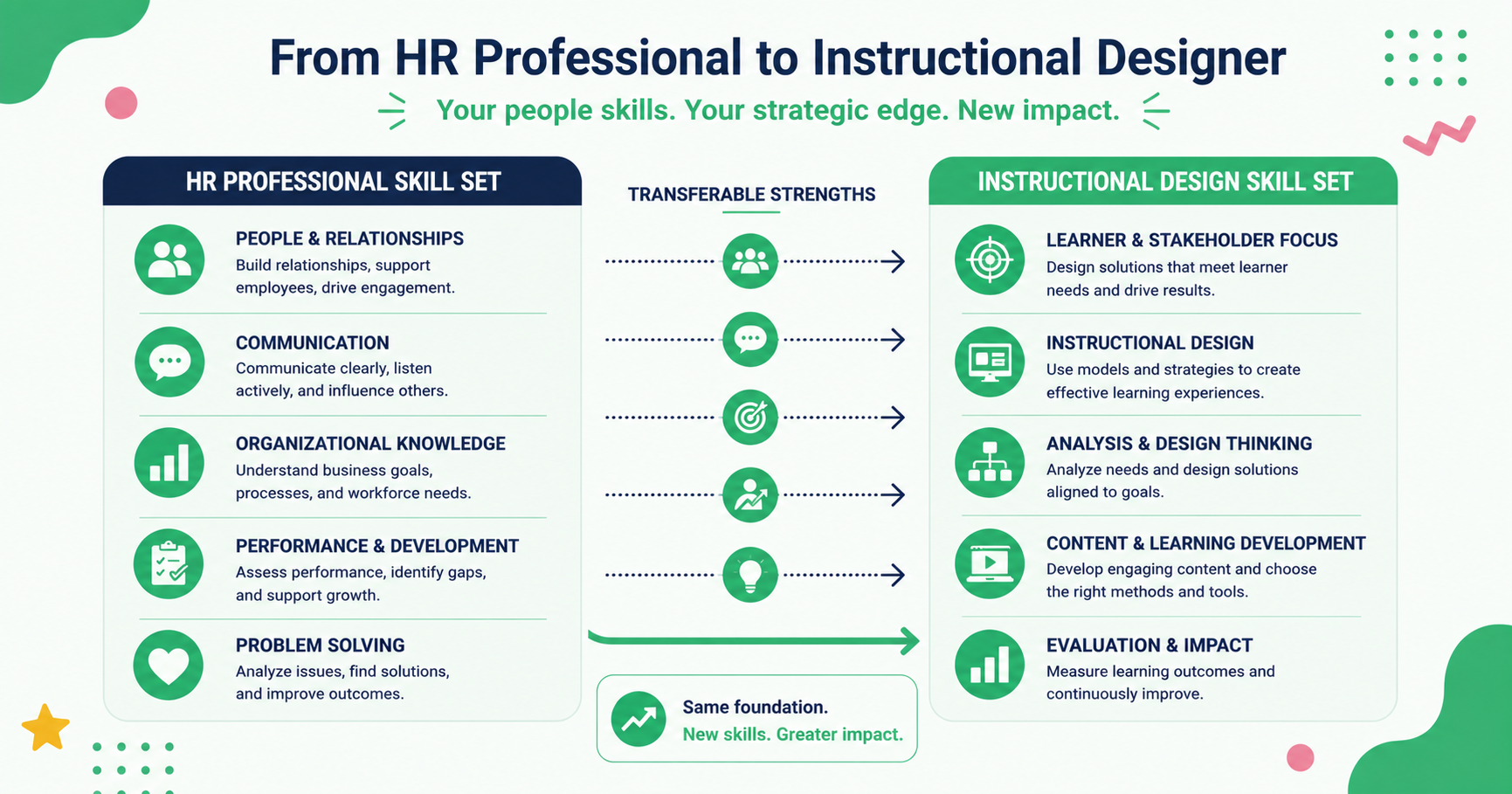 Most HR professionals are already doing parts of the ID process. The formal framework fills in the rest.
Want to see if instructional design is the right move for you?
IDOL Academy is a GNPEC-authorized 24-week program that combines 16 Credly-verified credentials, built-in AI training, and a real internship milestone, all at a price point below comparable bootcamps.
Try IDOL Academy FreeHow instructional design salaries compare to HR roles
Salary is usually one of the first questions HR professionals ask when they're considering this transition. The honest answer is: the ranges overlap, and where you land depends heavily on industry, specialization, and whether you're positioning yourself for a generalist HR training role versus a dedicated ID position in tech or healthcare.
According to the U.S. Bureau of Labor Statistics, the median annual wage for HR specialists is $67,650. Training and development specialists median $63,080. Instructional coordinators median $74,620. Those are median figures across all industries and experience levels. Senior instructional designers in corporate L&D, especially in tech, financial services, and pharma, frequently earn $90,000 to $120,000 or more.
| Role | BLS Median Annual Wage | High-end range (corporate/tech) |
|---|---|---|
| HR Specialist | $67,650 | $80,000–$100,000 |
| Training and Development Specialist | $63,080 | $85,000–$105,000 |
| Instructional Coordinator | $74,620 | $90,000–$120,000+ |
| Senior Instructional Designer (tech/pharma) | N/A (included above) | $110,000–$145,000 |
The more important number for most HR professionals making this move is the trajectory. HR generalist roles can plateau. Instructional design, particularly for people who develop strong portfolio work, authoring tool skills, and AI fluency, has a clear upward path into L&D manager, director, and learning strategist roles.
What's the difference between HR training coordination and instructional design?
This is where a lot of HR professionals get stuck. They've been scheduling training, managing vendors, running new-hire orientation, and tracking completions in the LMS for years. That's valuable experience. But it's not the same as instructional design.
Training coordination is logistics. Instructional design is architecture. One manages what already exists. The other creates what doesn't exist yet and makes deliberate decisions about how learning should be structured, sequenced, and assessed to produce a specific behavior change in a specific audience.
Here's a concrete example. An HR training coordinator receives a mandate to deliver anti-harassment training by Q3. They find a vendor, schedule sessions, send calendar invites, track completions, and report to the CHRO that 94% compliance was achieved. An instructional designer in that same scenario asks: what specific behaviors do we want employees to exhibit after this training? Is instructor-led the right format for this learning objective? How will we measure behavior change at 30 and 90 days? Then they build something that answers those questions, whether that's a scenario-based eLearning module, a facilitated workshop with post-training practice activities, or a blended solution.
That shift from coordinator to designer mindset is teachable. It's also exactly what a good ID program will walk you through systematically.
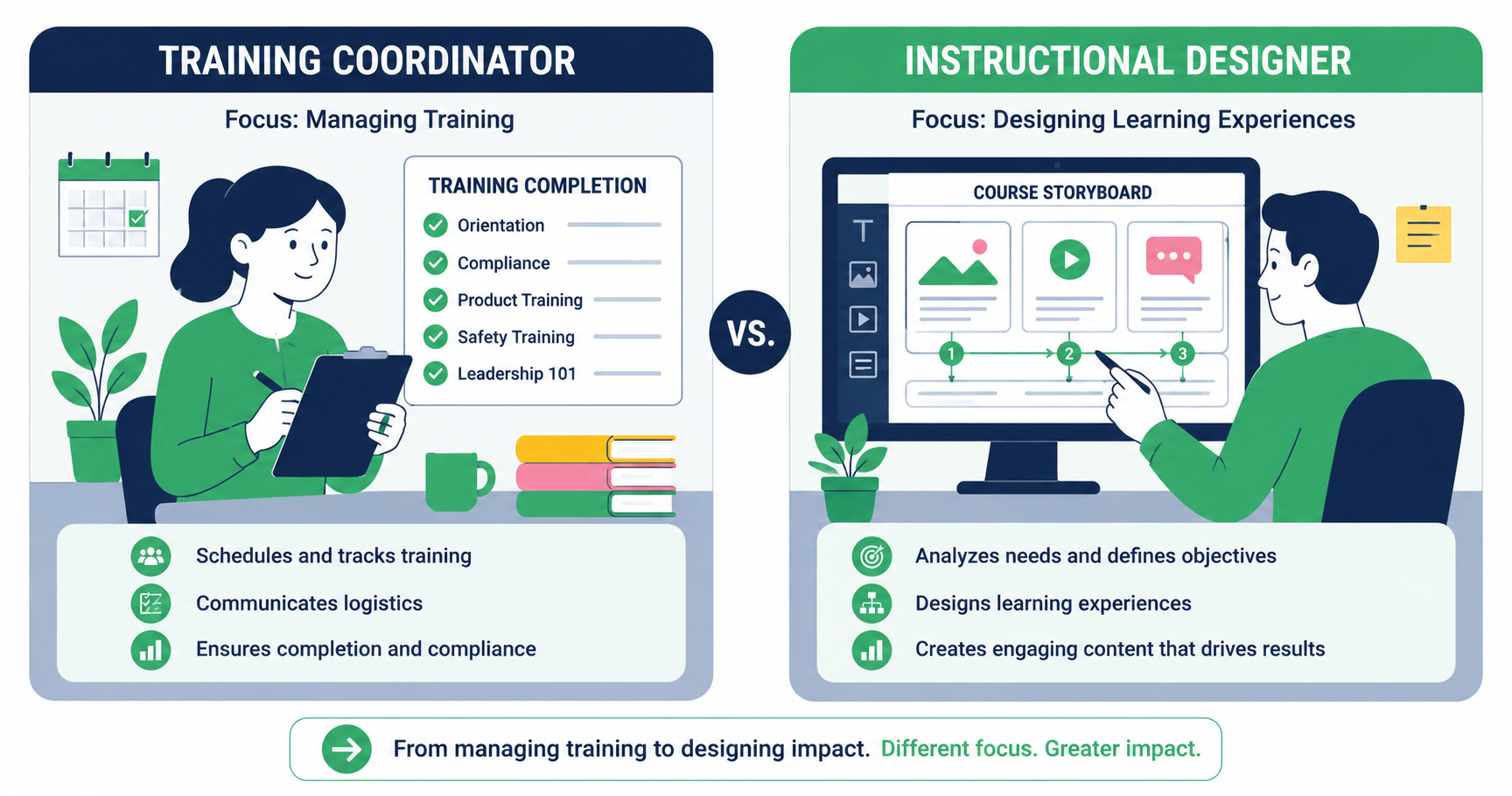 Training coordination and instructional design require different mindsets. Both matter. One is a foundation for the other.
How to make the transition from HR into instructional design without starting over
You don't need to quit your job, go back to school full-time, or spend two years in a master's program before you can start applying for ID roles. What you need is a plan that builds your skills and your portfolio at the same time, ideally while you're still employed.
Here's what a realistic transition looks like for most HR professionals:
- Start with a structured program. You need the methodology first. Trying to learn ADDIE, Storyline, and portfolio building simultaneously from YouTube will take years longer than it needs to. A program with a clear sequence and milestone accountability compresses that timeline significantly.
- Use your current role for real projects. If your organization has any training need at all, you have the raw material for portfolio pieces. A better onboarding module. A compliance refresher course you actually build instead of just scheduling. A job aid that solves a real performance problem on the floor. Real projects beat fictional samples every time.
- Get your credentials verified and visible. Hiring managers who don't know you personally need a way to verify your skills quickly. Digital badges on LinkedIn, especially from a recognized credentialing platform like Credly, signal competence without requiring a portfolio review before an initial screen.
- Learn the tools that are actually in job postings. Articulate Storyline, Articulate Rise, Camtasia, and basic Adobe tools appear in the majority of corporate ID job listings. Your HR experience in HRIS platforms shows you can learn complex software quickly. Add the ID-specific tools and you're competitive.
- Build your network in L&D, not just HR. LinkedIn, ATD chapter events, and ID-specific communities like IDOL Nation are where hiring managers and L&D directors spend their time. Start showing up there six months before you start applying.
At IDOL Academy, we have a lot of HR professionals move through the program. They bring context that makes their projects sharper than average from day one. The 24-week structure keeps them on pace, the 8 milestone gates ensure they're building as they go, and the internship pathway gives them real project experience they can point to in interviews. That combination of credentials, portfolio, and experience is what gets you through the door.
The program awards 16 Credly-verified badges (8 core milestone badges, 5 tool badges, and 3 AI certification badges through IDOLai), and the credential you earn is the CPTP: Certified Professional in Training and Performance. Those credentials give you something concrete to show before your portfolio is fully built. And the program is authorized by the Georgia Nonpublic Postsecondary Education Commission (GNPEC), which means it carries regulatory standing, not just a certificate you printed yourself.
If you're wondering how a certificate program stacks up against a full master's degree for this career move, the Instructional Design Certificate vs. Master's Degree article breaks that comparison down in detail. The short version: it depends on what you already have and where you want to land, but for most career-changers coming from HR, a certificate plus a strong portfolio outperforms a master's degree in time-to-hire.
Frequently Asked Questions
Can HR professionals transition into instructional design?
Yes, and they often transition more smoothly than people expect. HR professionals already understand how organizations work, how people learn on the job, and what training is supposed to accomplish. The gap is usually in formal ID methodology and authoring tool skills, both of which are trainable in a structured program.
What skills from HR transfer directly to instructional design?
Several skills carry over directly: needs assessment, stakeholder communication, compliance knowledge, adult learning principles, and project coordination. HR professionals who have managed onboarding programs or coordinated vendor-led training have already been doing parts of the instructional design process without the formal title.
Do I need a master's degree to become an instructional designer from HR?
No. A master's degree is one path, but it is not the only one. Many hiring managers in L&D prioritize portfolio work and demonstrated tool skills over graduate degrees. A focused certificate program that builds a real portfolio, teaches the core authoring tools, and earns you verifiable credentials can get you hired just as effectively, usually faster and for significantly less money.
How long does it take an HR professional to transition into instructional design?
Most people who take a structured approach, meaning a formal program plus active portfolio building, are job-ready within 6 to 12 months. IDOL Academy's 24-week program is designed to get you to that point, including a real internship milestone, while you remain in your current role.
What does an instructional designer in HR actually do?
An instructional designer in an HR or L&D function designs, builds, and evaluates training programs for employees. That includes onboarding courses, compliance modules, leadership development content, performance support tools, and sometimes the LMS infrastructure that delivers it all. The role sits at the intersection of strategy and production.
How much do instructional designers earn compared to HR generalists?
According to the U.S. Bureau of Labor Statistics, the median annual wage for training and development specialists is $63,080, while instructional coordinators earn a median of $74,620. HR specialists median $67,650. The ranges overlap, but senior instructional design roles at large organizations frequently pay into six figures, particularly in tech and healthcare.
If you're in HR and you've been wondering whether instructional design is the right next move, the answer is almost certainly yes. You already have the organizational context. What you need now is the methodology, the tools, and the portfolio to prove it.
Want to see if instructional design is the right move for you?
IDOL Academy is a GNPEC-authorized 24-week program that combines 16 Credly-verified credentials, built-in AI training, and a real internship milestone, all at a price point below comparable bootcamps.
Try IDOL Academy Free```