What Does an Instructional Design Portfolio Need to Include?
Jul 10, 2026
What Does an Instructional Design Portfolio Need to Include?
By Dr. Robin Sargent · Founder, IDOL Academy · Last updated: July 14, 2025 · 10 min read
Quick answer
A strong instructional design portfolio needs 3 to 5 samples built in industry-standard tools, a process document or case study for each piece, an about page with your design philosophy, and a clean website format. Spec projects count. You do not need real clients to get started.
In this article
- Why your portfolio matters more than your resume
- The five things every instructional design portfolio must have
- What types of samples should you include?
- How to build a portfolio when you have no ID experience
- Common portfolio mistakes that cost you the interview
- How IDOL Academy builds your portfolio into the program
- Frequently asked questions
Your instructional design portfolio is the single most important thing you need to get hired. Not your resume, not your degree, not your LinkedIn headline. Hiring managers in L&D want to see what you can actually build, and they want to see your thinking behind it. A well-constructed instructional design portfolio shows both in under five minutes of browsing.
Why your portfolio matters more than your resume
Instructional design is a production role. You are hired to make things: courses, job aids, videos, simulations, performance support tools. A resume tells a hiring manager what you say you did. A portfolio proves it.
This is actually good news for career changers. You are competing against candidates who have longer resumes, more years in the field, and more recognizable job titles. But if your portfolio is cleaner, better organized, and more clearly reasoned than theirs, you win the interview. I have seen it happen hundreds of times.
According to the U.S. Bureau of Labor Statistics, training and development specialist roles are projected to grow 6 percent through 2033, faster than the average across all occupations. The market is growing. The competition is growing with it. Your portfolio is how you stand out.
What a hiring manager actually does when they land on your portfolio: they spend about 90 seconds scanning the homepage, click one sample, look at it for two to three minutes, then decide whether to read anything else. Your portfolio needs to pass that 90-second test immediately. If they can't tell what you do and why your work is good in under two minutes, you've lost them.
The five things every instructional design portfolio must have
Not every portfolio looks the same, and that's fine. But every portfolio that actually lands interviews has these five components.
1. An about page that explains your design philosophy
This is not a bio. This is a positioning statement. It tells the hiring manager what kind of designer you are, what you believe about how people learn, and what you bring to the table specifically. Two to three paragraphs. Write it in plain language, not buzzwords. "I design for the moment when someone is back at their desk trying to remember what to do" is more compelling than "I create learner-centered experiences."
2. Three to five portfolio samples
Three strong samples beat ten mediocre ones. Period. Each sample should represent a different format or tool if possible. An eLearning module in Articulate, a video, and a job aid is a solid trio. We'll go deeper on sample types in the next section.
3. A process document or case study for each sample
This is where most career changers leave points on the table. They show the finished product and nothing else. A short case study, even just a half page, that explains the audience, the performance gap, the design decisions you made, and why, tells a hiring manager that you can think like a designer. Anyone can click buttons in Articulate. Not everyone can explain why they made the choices they made.
4. A clean, navigable website
Your portfolio site does not need to be fancy. It needs to load fast, work on mobile, and not require the hiring manager to download anything to see your work. Google Sites, Wix, and Squarespace all work. The design of the site itself is a signal. If it's cluttered, confusing, or hard to navigate, that reflects on your design judgment.
5. Contact information and a link to your LinkedIn
Make it easy to reach you. Put your email address on the page. Not buried in a contact form, on the page. If someone likes your work and wants to invite you for an interview, they should not have to dig for your contact details.
"Anyone can click buttons in Articulate. The case study is where you prove you can think." — Dr. Robin Sargent
What types of samples should you include?
You want range. Not every format, but enough variety to show you aren't a one-trick designer. Here is how different sample types compare in terms of what they signal to a hiring manager:
| Sample Type | Tool | What It Signals |
|---|---|---|
| eLearning module | Articulate Storyline or Rise | Core tool proficiency; ability to structure branching or linear content |
| Explainer or instructional video | Camtasia or similar | Multimedia production; ability to simplify and sequence |
| Job aid or quick reference guide | Canva, InDesign, or Word | Performance support thinking; visual design basics |
| Facilitator guide or ILT deck | PowerPoint or Google Slides | Instructor-led design skills; useful for orgs with live training |
| Design document or storyboard | Word, Notion, or custom template | Process rigor; shows you plan before you build |
The most competitive portfolios include at least one Articulate Storyline module. Storyline is the most widely required tool in job postings for instructional designers. If you don't have it in your portfolio, you are at a disadvantage for most corporate L&D roles. Rise is a strong second, and it is faster to build with, which makes it a practical choice for spec projects.
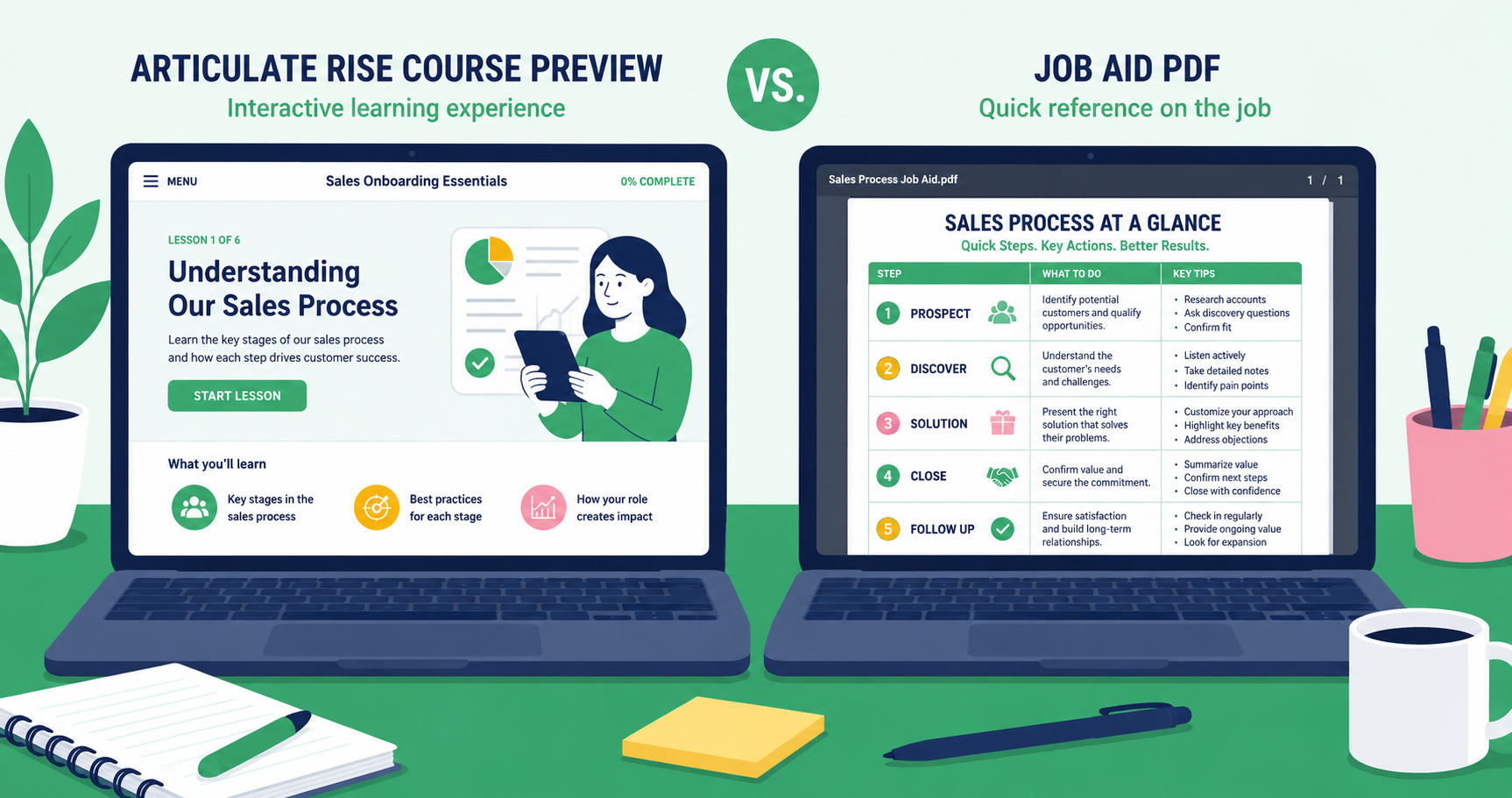 A strong portfolio includes multiple formats: eLearning modules, video, and performance support tools like job aids.
Want to see if instructional design is the right move for you?
IDOL Academy is a GNPEC-authorized 24-week program that combines 16 Credly-verified credentials, built-in AI training, and a real internship milestone, all at a price point below comparable bootcamps.
Try IDOL Academy FreeHow to build a portfolio when you have no ID experience
This is the question I get most often from career changers. "I don't have any instructional design projects. How do I build a portfolio?"
You build it with spec projects. A spec project is a sample you design from scratch, as if you had a real client, but without one. You pick a realistic scenario, define the audience and performance gap, design the solution, and build it. It doesn't matter that there's no real company behind it. What matters is that your thinking is sound and your execution is clean.
Here is a simple approach to spec project selection:
- Pick a topic you know well, ideally from your current or previous career. A teacher making a transition might build a module on classroom management for new teachers. A nurse changing careers might design a safety compliance course for a fictional healthcare org.
- Write a one-paragraph scenario that explains the audience, the problem, and the goal of the training. This becomes the basis for your case study.
- Build the module, video, or job aid as if a real stakeholder will review it. Hold yourself to the same standard you'd hold professional work.
- Write the case study after. Explain your design decisions. What did you consider? What did you cut? What would you do differently with more time or budget?
Hiring managers at companies like Google and Amazon have L&D teams that regularly hire instructional designers without prior corporate experience, specifically because those candidates bring domain expertise from other fields. Your background as a teacher, nurse, accountant, or project manager is not a liability. It is a differentiator. Your portfolio is how you frame it that way.
One more thing: do not put everything you've ever built in your portfolio. Spec projects you built while learning but aren't proud of should stay off the site. Your portfolio is a curated collection, not a complete archive. Three pieces you stand behind beat eight pieces of varying quality every time.
Common portfolio mistakes that cost you the interview
I've reviewed a lot of portfolios. Here are the mistakes I see most often from career changers who are otherwise strong candidates.
No context around the samples
A finished module with no explanation looks like a demo reel, not a design portfolio. Add the who, what, and why for every piece. Even two or three sentences is better than nothing. A full case study is better still.
Using only one tool
Five Articulate Rise modules is not a portfolio. It's one skill demonstrated five times. Show range. One eLearning build, one video, one print-format piece. That tells a hiring manager you can pick the right tool for the job.
The about page reads like a resume
"I have 10 years of experience in education and am passionate about learning." That tells me nothing useful. Write your about page to answer the question: "Why should I hire this person to solve my team's training problems?" Be specific. Be direct. Sound like a person.
Samples that require a download to view
If your Articulate module only exists as a .story file or a zipped package, a busy hiring manager will not open it. Publish your Articulate modules to Review 360 or to a hosted web folder. Every sample on your site should be viewable in a browser within two clicks.
Outdated or broken links
Test every link in your portfolio before you apply anywhere. A 404 error on your portfolio sample is a red flag about your attention to detail. Check your links every few months. Hosted demos can expire or move.
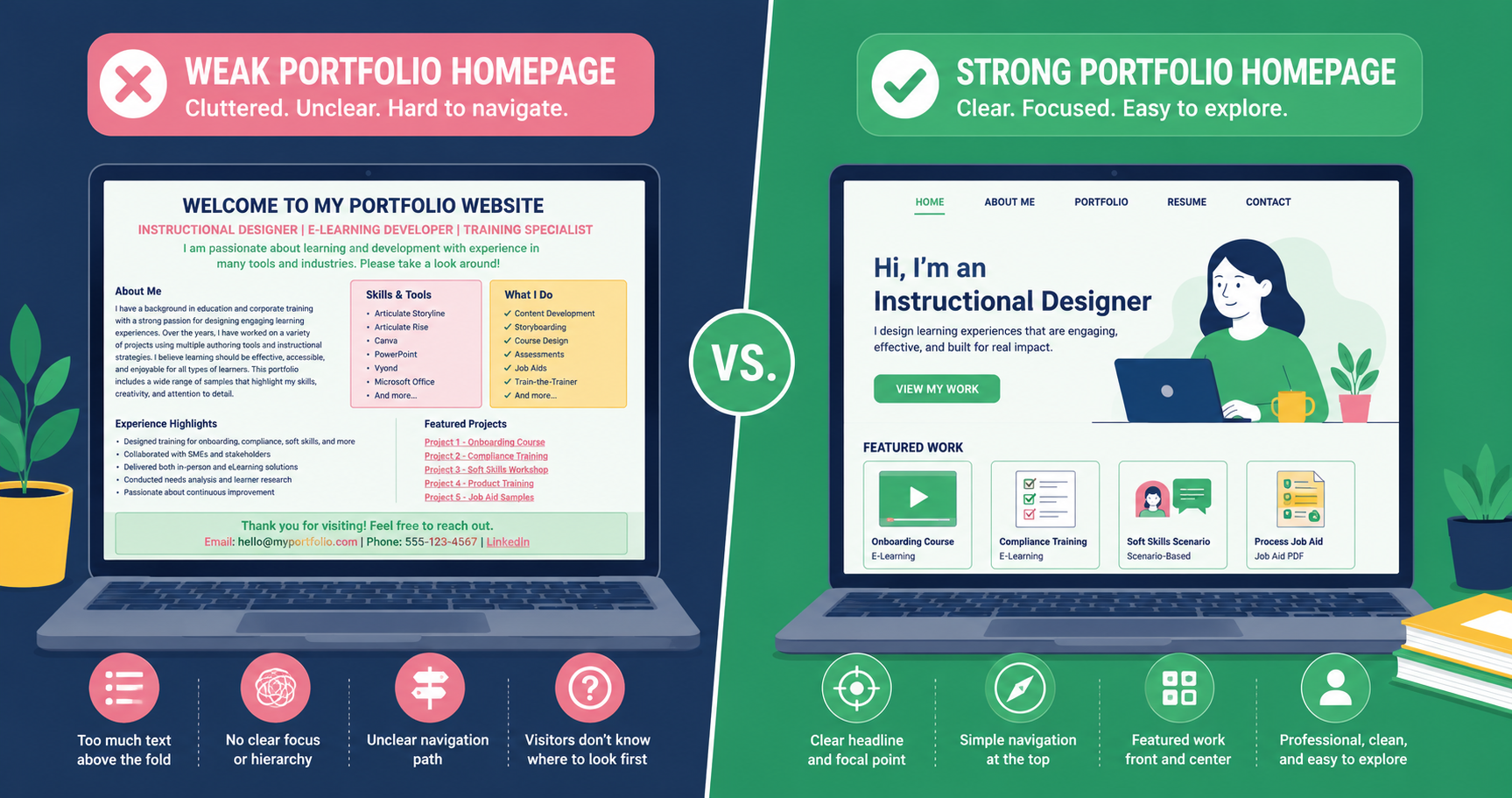 The portfolio on the right passes the 90-second test. The one on the left doesn't make it past the first click.
How IDOL Academy builds your portfolio into the program
One of the reasons I built IDOL Academy the way I did is because I knew that most instructional design programs, whether master's degrees or short bootcamps, don't prioritize the portfolio. They prioritize curriculum. You learn theory, maybe get some tool exposure, and then you're on your own to figure out how to package yourself for the job market.
IDOL Academy is structured differently. Every milestone in the 24-week program produces something portfolio-ready. By the time you complete all 8 milestones, you have:
- At least one Articulate Storyline module with branching scenarios
- At least one Articulate Rise course
- A video-based learning asset built in Camtasia
- A design document or storyboard showing your process
- A completed portfolio site with case studies
- 16 Credly-verified badges, including 3 AI certifications through IDOLai
The program is authorized by the Georgia Nonpublic Postsecondary Education Commission (GNPEC) and graduates earn the CPTP credential, Certified Professional in Training and Performance, upon completion. Those badges are verifiable on Credly, which means a hiring manager can confirm your credentials in about 30 seconds.
The internship milestone is also portfolio-relevant. IDOL Academy offers 4 internship pathways, most completable without leaving your current job. The work you produce during the internship is real, done for a real organization, and goes directly into your portfolio. That's the difference between a spec project and a real-world sample, and it matters to hiring managers.
You can explore more about how IDOL Academy is structured in the IDOL Academy Knowledge Base, including details on the milestone system and credentialing process.
Frequently Asked Questions
How many samples do I need in my instructional design portfolio?
Three to five strong samples is the standard. Hiring managers do not read every piece, they scan for evidence of your thinking process and your range. Three polished, well-contextualized pieces outperform ten mediocre ones every time. Quality matters far more than volume.
Can I build a portfolio without any work experience in instructional design?
Yes. You build it with spec projects, which are samples you create from scratch without a client. Choose a realistic scenario, design a module or job aid as if it were real, and document your process. Most career changers build their first portfolio entirely from spec work, and it is completely acceptable to hiring managers who understand how career transitions work.
Should my portfolio be a website or a PDF?
A website is strongly preferred. It lets you link directly to published Articulate Rise or Storyline demos, embed video, and update your samples without resending files. Free platforms like Google Sites or Wix work fine. A PDF is acceptable as a backup but should never be your primary format.
What tools should my portfolio samples be built in?
The market standard tools are Articulate Storyline and Articulate Rise. Samples in those tools signal that you are job-ready without additional training. A video sample edited in Camtasia and a PDF job aid round out a well-balanced portfolio. Tool training for Articulate and Camtasia is included in IDOL Academy's curriculum.
Do I need to include an ADDIE or SAM process document in my portfolio?
Not a full process document, but you should show your thinking. A one-page design document, a needs analysis summary, or a brief written case study for each sample demonstrates that you can solve a business problem, not just build a pretty slide. That context is what separates a portfolio from a gallery.
How long does it take to build an instructional design portfolio?
Realistically, 8 to 12 weeks if you are working on it alongside a full-time job. That timeline assumes you already have some tool training. If you are starting from scratch with no experience in Articulate or Camtasia, plan for 16 to 24 weeks, which is exactly why IDOL Academy's 24-week program is structured to produce a complete portfolio by graduation.
Your instructional design portfolio is not a finishing-school project you do after you're ready. It's how you get ready. Build it with intention, document your thinking, and put it in front of hiring managers in a format they can actually review. That's how career changers break in.
Want to see if instructional design is the right move for you?
IDOL Academy is a GNPEC-authorized 24-week program that combines 16 Credly-verified credentials, built-in AI training, and a real internship milestone, all at a price point below comparable bootcamps.
Try IDOL Academy Free```