How Teachers Transition into Instructional Design
Jul 02, 2026
How Teachers Transition into Instructional Design
By Dr. Robin Sargent · Founder, IDOL Academy · 10 min read
Quick answer
Teachers transitioning to instructional design typically take six to twelve months. You close the skills gap by learning authoring tools and corporate L&D processes, build a portfolio of real projects, and earn a recognized credential. Your classroom background is a genuine asset, not something to explain away.
In this article
- Why teachers are well-positioned for instructional design
- What skills you actually need to add
- How corporate L&D is different from the classroom
- How to build a portfolio before you have corporate experience
- What the transition path looks like, step by step
- Salary comparison: teaching vs. instructional design
- Frequently asked questions
Teachers transitioning to instructional design already have the hardest skills: you know how people learn, how to write objectives, and how to sequence content so it actually sticks. What you are missing is the corporate context, the tools, and the portfolio. Those are learnable. Fast. This article walks you through exactly what the transition looks like and what you need to do to make it.
Why teachers are well-positioned for instructional design
Let's be honest about what instructional design actually is. You are analyzing a performance gap, identifying what someone needs to learn to close it, designing a learning experience that works, and then measuring whether it worked. That is lesson planning with a different vocabulary and a bigger budget.
Teachers do this every day. The difference is that in K-12 or higher ed, you are working within a mandated curriculum. In corporate L&D, you are often starting from scratch with a subject matter expert, no textbook, and a six-week deadline. The process is the same. The environment is different.
Here is what you bring to an instructional design role that people without a teaching background genuinely cannot fake:
- Writing clear, measurable learning objectives. Most non-teachers write objectives that are actually activities, not outcomes. You already know the difference.
- Sequencing content logically. You have built curriculum before. You know that you cannot teach the Civil War without the context of Reconstruction, and you know how to scaffold complex concepts.
- Reading learner engagement signals. You have spent years adjusting on the fly when something is not landing. That instinct transfers directly into course design decisions.
- Writing for an audience. You have written rubrics, instructions, and assessments that actual humans have to understand. That is harder than it sounds.
- Differentiating for different learners. Universal Design for Learning is not a new concept to you. Corporate L&D is just now catching up to what good teachers have been doing for years.
These are the competencies that take years to develop. You already have them. The gap you need to close is on the technical and contextual side, and that is exactly where a focused certificate program delivers the fastest return.
What skills you actually need to add
Here is where teachers usually need to do real work. None of this is insurmountable, but going in with eyes open saves a lot of frustration.
Authoring tools
The corporate L&D world runs on Articulate Storyline and Articulate Rise. If you have never opened either tool, that is the single biggest skills gap to close. Adobe Captivate is still used in some organizations. Camtasia handles screen recording and video editing. Knowing at least Storyline and Rise puts you in the conversation for the majority of job postings. Tool training is not something you need to figure out on your own. A structured program will walk you through it.
Instructional design models
ADDIE and SAM are the frameworks most corporate teams use. You will recognize the logic immediately because it maps to lesson planning. The vocabulary is different. The process is familiar. Understanding how to apply these models and talk about them fluently is a job interview requirement.
Visual design fundamentals
You do not need to be a graphic designer. You need to understand contrast, alignment, proximity, and repetition well enough to build slides and screens that do not look like a ransom note. Most teachers have never had to think about this explicitly. It is a learnable skill, and it matters more than most people expect.
Needs analysis and working with subject matter experts
In a corporate environment, you do not know the content the way you knew your subject area in the classroom. You are extracting knowledge from a subject matter expert (SME) who is often busy, sometimes inarticulate, and occasionally convinced that a 200-slide deck is a training solution. Learning how to conduct a proper needs analysis and manage an SME relationship is a skill set you build deliberately.
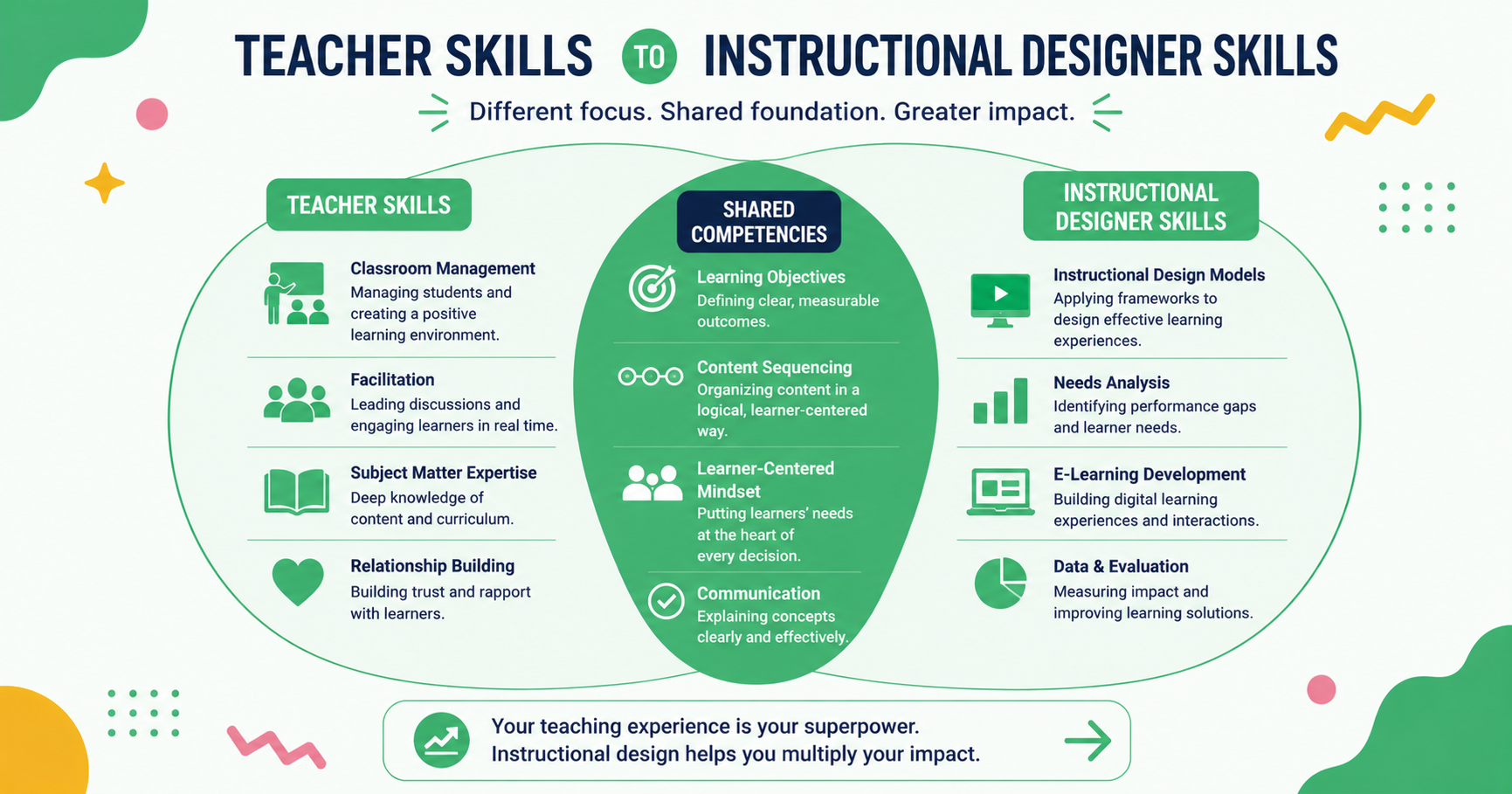 The overlap between teaching skills and instructional design skills is larger than most people expect. The gap is real but narrow.
How corporate L&D is different from the classroom
This is the context shift that trips up more teachers than the technical skills do. Understanding it before you walk into your first interview is a significant advantage.
In corporate L&D, you are designing for adult learners who have a job to do and limited time to spend in training. They are not sitting in your class because the state requires it. They are there because a business problem needs solving, and training is one possible solution. Sometimes it is not even the right solution. Part of your job is figuring out whether training is actually what is needed.
A few other things that are different:
- Speed. Corporate projects move fast. A six-week turnaround on a full eLearning module is not unusual. Semester-long curriculum development cycles do not exist here.
- Stakeholders. You are not just answering to a department chair or principal. You are managing expectations from L&D managers, business unit leaders, legal compliance teams, and sometimes executives. Learning to navigate that is a skill.
- ROI framing. Corporate L&D has to justify its existence in business terms. You will be expected to tie learning outcomes to performance metrics. This is not how most teachers think about assessment, and it requires a mental reframe.
- Technology ownership. You are often the most technical person in the room. Nobody is handing you a textbook. You are building the thing from scratch in a tool you are responsible for knowing.
"You do not leave teaching behind when you become an instructional designer. You take the best parts of it into a room where the conditions are finally in your favor." — Dr. Robin Sargent
Want to see if instructional design is the right move for you?
IDOL Academy is a GNPEC-authorized 24-week program that combines 16 Credly-verified credentials, built-in AI training, and a real internship milestone, all at a price point below comparable bootcamps.
Try IDOL Academy FreeHow to build a portfolio before you have corporate experience
This is the question every teacher asks and the answer is simpler than people make it. You build portfolio pieces. You do not wait for someone to hire you first.
A credible entry-level portfolio has three things: an eLearning module built in Storyline or Rise, a job aid or performance support document, and some form of needs analysis or design document. The content does not have to come from a corporate client. It can come from a training scenario you invent, a nonprofit you volunteer with, or a module you build based on your own teaching subject area reframed for an adult professional audience.
What matters is that the work demonstrates that you can do the job, not that you have already been paid to do it. Hiring managers at companies like Amazon and Google review portfolio links in applications. They are looking at the quality of your decisions, your visual design, and how clearly you write objectives and assessments. They are not counting years of corporate experience.
At IDOL Academy, portfolio building is not a side project you figure out on your own. It is built into the structure of the program. Each of the 8 milestone gates requires you to produce real deliverables, and the internship milestone is specifically designed to get you working on a real project with a real organization before you graduate. Four internship pathways exist, and most are completable without leaving your current teaching position.
What the transition path looks like, step by step
Here is a realistic timeline for a teacher making this move deliberately.
Months one through six: build the foundation. Enroll in a structured certificate program. Learn Storyline and Rise. Build your first two portfolio pieces. Understand the ADDIE and SAM models well enough to talk through them in an interview. Earn your first few credentials.
Months five through eight: complete the internship. Use the internship milestone to produce work for a real client or organization. This gives you something concrete to discuss in interviews: a real project, a real stakeholder, real constraints, real decisions you made and why.
Months seven through ten: earn your credential and start applying. The CPTP (Certified Professional in Training and Performance) is a Credly-verified credential you can display on LinkedIn and link from your resume. Pair it with your portfolio and start applying for instructional designer roles, learning experience designer roles, and eLearning developer roles. Many teachers also start with an internal transfer, moving from a classroom teaching role into an L&D or training specialist role within their existing school district or university.
Months nine through twelve: land the role. Most teachers who complete this process and apply consistently land a role within three to six months of finishing their program. The U.S. Bureau of Labor Statistics projects 2% job growth for instructional coordinators through 2033, but the demand for eLearning developers and corporate instructional designers is significantly higher than that projection captures, since those roles sit under multiple job classification codes.
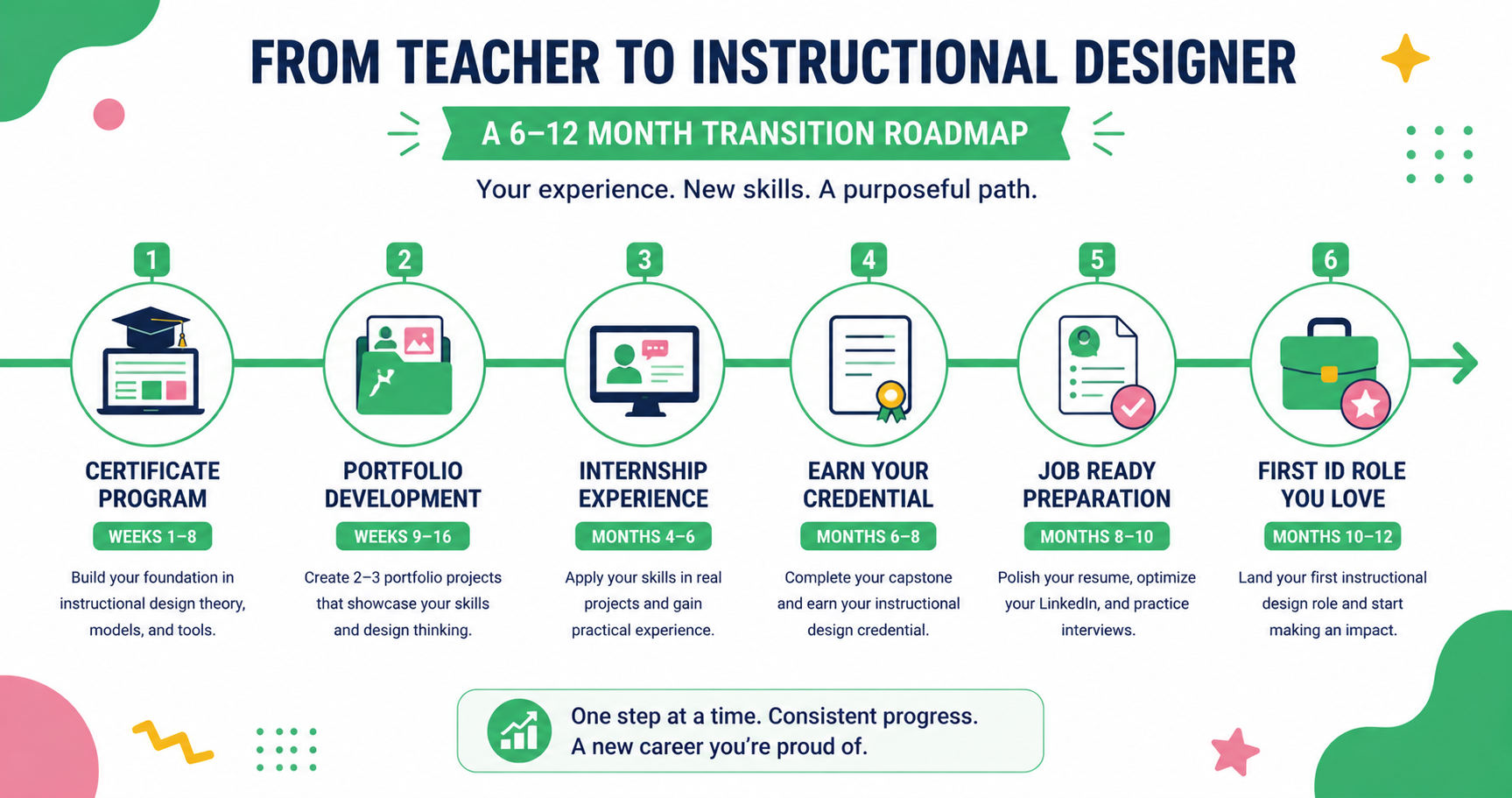 A realistic timeline from classroom to corporate L&D role.
Salary comparison: teaching vs. instructional design
This is usually the first question people ask, so here are the numbers without editorializing. All figures are from the U.S. Bureau of Labor Statistics Occupational Outlook Handbook.
| Role | Median Annual Salary (BLS) | Notes |
|---|---|---|
| Elementary/Middle School Teacher | $61,690 | Public school; varies significantly by state and district |
| High School Teacher | $62,360 | Public school; subject area affects placement |
| Instructional Coordinator | $77,990 | BLS code covers instructional designers and coordinators |
| Corporate Instructional Designer (Entry) | $55,000–$72,000 | Industry and location dependent; tech sector skews higher |
| Senior Instructional Designer | $90,000–$130,000+ | 3+ years experience, tech, healthcare, or financial services |
The salary increase is real, but it is not the most important number for most teachers making this move. The more important number is the range of environments available to you. Instructional designers work in tech, healthcare, financial services, government, nonprofits, higher ed, and consulting. If you burn out on one sector, you move to another without starting over. That flexibility does not exist in classroom teaching in the same way.
Frequently Asked Questions
Do teachers need a master's degree to become an instructional designer?
No. Many working instructional designers hold a bachelor's degree plus a certificate and a strong portfolio. Employers hiring for corporate L&D roles care more about what you can build than what degree you hold. A certificate from an authorized program, combined with a portfolio of real projects, is a credible alternative to a master's degree for most entry-level and mid-level roles.
How long does it take a teacher to transition into instructional design?
Most teachers complete the career transition in six to twelve months. A structured 24-week program like IDOL Academy covers the core skills and portfolio-building simultaneously, so you are not spending years in school before you can apply. Timeline also depends on how quickly you land your first role after completing your training.
What transferable skills do teachers bring to instructional design?
Teachers bring several skills that are genuinely hard to teach: writing clear learning objectives, sequencing content logically, reading a room and adjusting delivery, giving feedback on performance, and differentiating instruction for different learners. These map directly onto the core competencies of instructional design. The gap is usually on the technical side: authoring tools, rapid development software, and corporate L&D processes.
What salary can a teacher expect after moving into instructional design?
According to the U.S. Bureau of Labor Statistics, the median annual wage for instructional designers and coordinators is $77,990. Entry-level corporate roles commonly start in the $55,000 to $70,000 range, and experienced designers at large organizations can earn well above $100,000. That is a significant increase over the national median teacher salary, which the BLS reports at $61,690 for elementary and middle school teachers.
Do instructional designers still teach?
Not in the traditional classroom sense. Instructional designers design the learning experiences that others deliver, or they build self-paced digital courses. You move from being the person in front of the room to being the architect of what happens in the room or on the screen. Many teachers find this shift gives them more influence over learning outcomes, not less.
Is instructional design a good career for burned-out teachers?
It is one of the most common paths for teachers who love the work of education but are exhausted by the environment. Instructional design removes many of the stressors that burn teachers out: large class sizes, behavior management, administrative overload, and low pay. The work itself, designing how people learn, stays. The conditions change substantially.
Teachers transitioning to instructional design are not starting from zero. You are starting from a place most career changers would pay for. Learn the tools, build the portfolio, earn the credential, and get your work in front of hiring managers. The path is clear and the timeline is shorter than you probably think. If you want to see what that process looks like in a structured program, start with a free trial.
Want to see if instructional design is the right move for you?
IDOL Academy is a GNPEC-authorized 24-week program that combines 16 Credly-verified credentials, built-in AI training, and a real internship milestone, all at a price point below comparable bootcamps.
Try IDOL Academy Free```