What Is a Learning Record Store (LRS)?
Sep 21, 2026
What Is a Learning Record Store (LRS)?
By Dr. Robin Sargent · Founder, IDOL Academy · Last updated: August 27, 2026 · 11 min read
Quick answer
A learning record store is a database built to collect, store, and return learning activity data sent to it as xAPI statements. It records what people did across courses, simulations, mobile apps, and the job itself, not just whether someone finished a course inside a learning management system.
In this article
A learning record store, usually shortened to LRS, is a database designed to hold one thing: records of learning activity. Software sends it short statements about what somebody did, the LRS stores them, and reporting tools pull them back out. It exists because completion data alone never answered the question every learning team gets asked, which is whether the training worked.
What a learning record store actually does
Strip away the acronym and an LRS does three jobs.
- It receives. Any authorized system can send it a statement about a learning event. A course, a simulation, a mobile app, a headset, a form a manager fills in after a coaching session.
- It stores. Every statement lands in one standard format, so a statement from an Articulate Storyline course and a statement from a custom sales simulation sit side by side and mean the same thing structurally.
- It returns. A dashboard, a business intelligence tool, or even another LRS can query it and get the records back.
That is the whole product. An LRS does not deliver courses. It does not enroll anyone. It does not send reminder emails or run a catalog. It is plumbing, and it exists because the older plumbing had a hard ceiling.
If you have read our explainer on what SCORM is and why your LMS needs it, you already know that ceiling. SCORM carries four pieces of information back to a learning management system: launch, completion, score, and bookmark. It only reports while a learner sits inside a course the LMS launched. Close the course, and SCORM goes quiet.
Most workplace learning happens after the course closes. That gap is why the Advanced Distributed Learning Initiative, a research program inside the U.S. Department of Defense, developed the Experience API, commonly called xAPI. You can read the specification and the conformance requirements directly at the ADL Initiative xAPI project page. The LRS is the piece of that specification that holds the data.
Picture the stack in three layers and it stops feeling abstract. The authoring tool builds the experience. The delivery standard, SCORM or xAPI or cmi5, carries the report of what happened. The LRS is where that report lands and waits until somebody asks a question of it. cmi5 sits in the middle of that picture on purpose: it uses xAPI underneath, so the data goes to an LRS, while keeping the enrollment and launch behavior an LMS needs. Teams reach for cmi5 when they want richer data without giving up the administrative side of the LMS.
One thing an LRS is not: a dashboard. It stores and returns records. Turning those records into a chart somebody in the business will read takes a reporting layer on top, whether that is a vendor dashboard, a BI tool, or a spreadsheet somebody exports on Fridays. Plenty of organizations buy an LRS, connect nothing to it, and then conclude that xAPI does not work. The specification worked fine. Nobody asked it a question.
LRS vs LMS: what is the difference?
This is the question that trips up almost everyone new to the field, and the confusion is fair, because plenty of learning management systems now bundle an LRS inside them. The two still do genuinely different jobs.
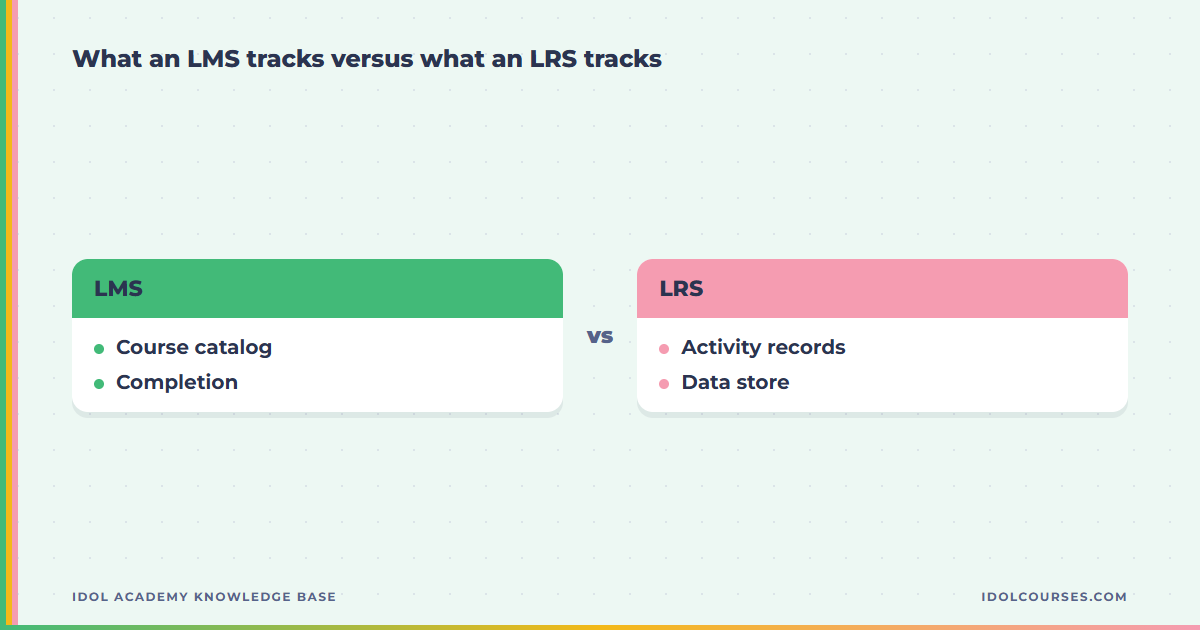
An LMS is the front door. It delivers training, enrolls people, runs the catalog, handles compliance deadlines, and reports on completion. An LRS is a filing cabinet with an API. It stores evidence of activity and gives it back on request.
| Question | LMS | LRS |
|---|---|---|
| Primary job | Deliver and administer training | Store and return learning activity data |
| Hosts courses | Yes | No |
| Tracks activity outside a course | No, not on its own | Yes, that is the point |
| Data standards used | SCORM, AICC, cmi5 | xAPI, cmi5 |
| Question it answers | Who finished the required training? | What did people actually do, and did it change anything? |
| Who usually owns it | L&D operations or HR systems | Learning technologist or data team |
One more distinction worth carrying into an interview. An LMS reports on the training. An LRS reports on the learner. Those sound similar and they are not. The first tells you how your catalog performed. The second tells you how a person behaved, which is the version a business leader actually cares about.
What an xAPI statement looks like
You do not need to write code to understand this part, and understanding it is what separates a candidate who has heard the term from one who can use it in a design conversation.
Every statement sent to an LRS follows one sentence pattern: actor, verb, object. That is deliberate. It reads like English because the specification authors designed it to.
- Maria completed the escalation simulation.
- Devon opened the pricing job aid.
- Priya attended the shadowing session.
- Andre failed the equipment check on the first attempt.
Statements can carry a result and a context as well. Result holds the score, the pass or fail, the duration. Context holds the situation: which team, which instructor, which parent activity, which attempt number. Stack a few thousand of those and you can answer questions no completion report ever could.
Here is the shape of a finding an LRS makes possible. Everyone completes the refund policy course. Refund errors do not drop. The activity data then shows people opening the refund job aid several times a week, months after the course, always at the same decision point. The training was not the problem. The policy branching was. That is a design finding, and it only exists because somebody recorded activity happening outside the course.
The trap on the other side is recording everything. It is easy to do, it feels thorough, and it produces a pile of data nobody can read. A better habit is to write the report before you write the statements. Decide the sentence you want to be able to say in ninety days, then work backward to the three or four events that would let you say it.
- The moment of difficulty. Where do people fail, retry, or hesitate? That is where your design is weakest and where the data is most useful.
- The moment of transfer. When somebody reaches for the material on the job rather than in the course, record it. That single event separates training that stuck from training that got completed.
- The moment of choice. In a branching scenario, the path a person picks tells you more about their mental model than the final score does.
Privacy deserves a sentence here as well, because it comes up fast in any real organization. An LRS holds records tied to individuals, so who can see the data, how long it stays, and whether reporting runs at the individual or team level are decisions made with legal and HR before the first statement gets sent, not after.
Want to see if instructional design is the right move for you?
IDOL Academy is a GNPEC-authorized 24-week program that combines 16 Credly-verified credentials, built-in AI training, and a real internship milestone, all at a price point below comparable bootcamps.
Try IDOL Academy FreeWhy an LRS changes the instructional design job
Most people entering this field picture the work as building courses. Building courses is part of it. The part that decides your salary and your seat at the table is whether you can say what happened afterward.
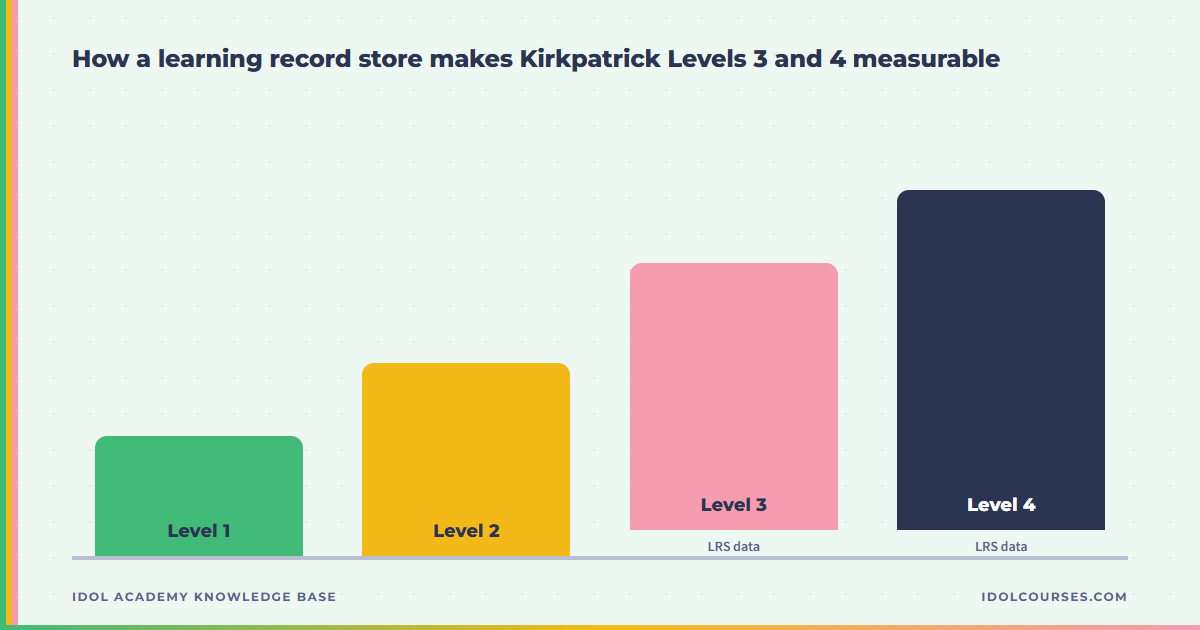
Think about the Kirkpatrick model for a second. Level 1 is reaction, the smile sheet. Level 2 is learning, the quiz score. Levels 3 and 4 are behavior and results, and nearly every L&D team says it wants those two and then measures the first two anyway.
The reason is not laziness. The tooling stopped at Level 2. An LMS tells you who finished and what they scored. It cannot see the job. An LRS receives statements from the systems where the job happens, which is what turns Level 3 from aspiration into measurement.
"Report completions and you are a content producer. Report behavior and you are a partner to the business." — Dr. Robin Sargent
This shift changes how you design, too. Once you know activity can be recorded anywhere, you stop treating the course as the entire intervention. You design the job aid, the practice reps, the manager check-in, and the course as one connected system, and you decide up front which moments are worth recording.
That decision belongs to design, not to engineering. Nobody on the data team knows which three behaviors predict whether the training took hold. You do, because you ran the needs analysis. Choosing what to record is instructional design work, and it goes to whoever in the room understands both sides.
Do you need to know this to get hired?
You do not need to administer an LRS. That job usually belongs to a learning technologist or an LMS administrator, and in smaller organizations it belongs to whoever holds the vendor login.
What you need is fluency at the level of a conversation. Specifically, do these four things without stalling.
- Explain in one sentence what an LRS stores and why an LMS cannot store it.
- Name the actor, verb, object pattern and give an example from a project you actually built.
- Say which two or three behaviors you would record for a given program, and defend the choice.
- Say honestly what you have not done yet. "I have not configured an LRS in production" costs you nothing and buys you credibility with the one person in the room who would have caught it anyway.
The small version you can build this week
If you want to move past talking about it, do the small version. Several vendors offer free sandbox tiers, so this costs you an evening rather than a budget.
- Open a free LRS sandbox account and find the endpoint and key it gives you.
- Take a short course or branching scenario you already built. Publish it for xAPI instead of SCORM, which in most authoring tools is one setting.
- Point it at the sandbox, run through the piece twice, and deliberately fail once so the data has something interesting in it.
- Pull one report. Screenshot it.
- Write three sentences under the screenshot: what you recorded, why you chose those events, and what you would change in the design because of what you saw.
Then add that as a delivery note to the piece in your instructional design portfolio. Those three sentences do more work in an interview than another polished screenshot of a slide, because they show judgment instead of output.
Two candidates submit portfolios containing the same branching scenario. One shows the scenario. The other shows the scenario, the statements it sends, and a report proving where people got stuck. Those are not the same application.
Inside IDOL Academy, this lives in the delivery half of the work. The eLearning Developer and Rapid Prototyping milestones cover packaging and publishing, and the internship milestone puts the whole loop against a real problem with a real audience. Every core milestone earns a badge an employer can verify through Credly, so the claim is checkable rather than assertable. For more foundational explainers, browse the IDOL Academy Knowledge Base.
Frequently Asked Questions
What is a learning record store in simple terms?
A learning record store is a database that collects records of learning activity sent to it as xAPI statements. Each statement follows an actor, verb, object pattern, such as Devon opened the safety job aid. The LRS stores those statements and hands them back when a report or dashboard asks for them.
What is the difference between an LRS and an LMS?
An LMS delivers and administers training. It hosts courses, enrolls people, and tracks completion. An LRS does none of that. It only stores learning activity data, including activity that happens outside any course, and it returns that data to reporting tools. Many modern learning management systems now include a built-in LRS.
Do you need an LRS if you already use SCORM?
No. SCORM reports launch, completion, score, and bookmark data straight into the LMS, and that covers a large share of standard compliance and onboarding training. You need an LRS when you want to record activity SCORM cannot see, such as simulations, mobile use, coaching sessions, or on-the-job performance.
Do instructional designers have to administer an LRS?
Rarely. Setting up and maintaining an LRS usually belongs to a learning technologist or an LMS administrator. Instructional designers are expected to know what an LRS does, decide which activities are worth recording, and write the reporting questions the data has to answer.
What are examples of learning record stores?
Learning Locker, Watershed, Veracity Learning, SCORM Cloud, and Yet Analytics are widely used learning record stores. Several learning management systems also ship with an LRS included. The ADL Initiative, which developed the xAPI specification, maintains conformance testing so that any conformant LRS accepts statements the same way.
Can you put an LRS project in an instructional design portfolio?
Yes, and it stands out. Sign up for a free LRS sandbox, send xAPI statements from a small course or simulation you built, then screenshot the resulting report. Add a short delivery note explaining which statements you chose to record and what question the data answered.
The short version
A learning record store holds the evidence that learning happened somewhere other than inside a course, which is where most of it happens. Knowing what it does moves you out of the order-taker seat and into the conversation about whether the work mattered.
Want to see if instructional design is the right move for you?
IDOL Academy is a GNPEC-authorized 24-week program that combines 16 Credly-verified credentials, built-in AI training, and a real internship milestone, all at a price point below comparable bootcamps.
Try IDOL Academy Free