What Is cmi5? The Standard That Connects SCORM and xAPI
Sep 21, 2026
What Is cmi5? The Standard That Connects SCORM and xAPI
By Dr. Robin Sargent · Founder, IDOL Academy · Last updated: September 4, 2026 · 9 min read
Quick answer
cmi5 is an xAPI profile that tells a learning management system how to launch a course, track the session, and report completion, while xAPI records what the learner actually did. In plain terms, cmi5 gives xAPI the launch and completion rules SCORM always had, so one package works in both worlds.
In this article
If you have searched for what is cmi5, you probably ran into it in a job posting or a request for proposal and could not tell whether it was a tool, a file format, or something you were supposed to already know. It is a specification. cmi5 defines how a learning management system launches an xAPI-based course, tracks the session, and receives a completion result. It is the piece that made xAPI usable inside a traditional LMS.
What is cmi5, exactly?
cmi5 is a specification maintained by the Advanced Distributed Learning Initiative, the same U.S. government group that produced SCORM. You can read the specification and its supporting documents on the ADL Initiative site. The name is a leftover from an older AICC working group, so do not try to decode it. It does not stand for anything useful.
The clean way to hold it in your head is this. xAPI is a language for describing learning activity. cmi5 is a set of grammar rules for speaking that language inside a learning management system. The specification is usually described as an xAPI profile, which is exactly what it is: a defined subset of xAPI, plus required behaviors, that everyone agrees to follow so systems built by different vendors can work together.
Three things sit inside the specification:
- A course structure file. An XML file that tells the LMS what the course contains and how it is organized.
- A launch mechanism. Rules for how the LMS opens the content and passes it the credentials it needs to report back.
- A set of required xAPI statements. Nine defined verbs, including launched, initialized, completed, passed, failed, and terminated, so every system agrees on what "finished" means.
That third item is the quiet reason cmi5 exists. Before it, two teams could both use xAPI correctly and still disagree on which statement counted as completion. Reporting broke. cmi5 removed the ambiguity.
What problem does cmi5 solve?
To see the problem, you have to look at what came before. Start with SCORM, which has been the default packaging standard in corporate learning since the early 2000s.
SCORM does one job well. It wraps your course in a zip file, the LMS opens it in a browser, and the course reports back four data points: launched, completed, score, and bookmark location. That is the ceiling. SCORM only works while the learner sits inside the LMS in a browser window, and it can only describe learning that looks like a course.
Most of what people actually learn at work does not look like a course. It looks like a job aid opened during a customer call, a simulation run three times before a certification attempt, a coaching conversation, a mobile checklist used on a factory floor. SCORM cannot see any of it.
xAPI, released in 2013, fixed that. It records activity as short statements in an actor, verb, object shape: "Maria completed the escalation simulation on the second attempt." Those statements can come from anywhere, and they get written to a Learning Record Store, which is the database built to hold them.
Then organizations tried to run a real training program on xAPI alone and hit the gap. xAPI says nothing about how a course gets launched from a catalog, how one attempt is separated from another, how a passing score is authorized, or which statement the LMS should treat as the completion of record. Teams got rich data and lost the ability to administer a course.
"SCORM could run a course but barely describe learning. xAPI could describe learning but not run a course. cmi5 is what happens when someone finally writes down the rules for both." — Dr. Robin Sargent
cmi5 vs SCORM vs xAPI
This is the comparison hiring managers expect you to be able to draw on a whiteboard. Here it is in one table.
| Question | SCORM | xAPI | cmi5 |
|---|---|---|---|
| What is it | A packaging and runtime standard | A data specification | An xAPI profile with launch rules |
| Where data is stored | Inside the LMS | In a Learning Record Store | In a Learning Record Store |
| Works outside the browser session | No | Yes | Yes |
| LMS can launch and assign it | Yes | Not defined | Yes |
| Completion rules | Defined, but limited | Left to each team | Defined by the specification |
| Typical adoption today | Very high | Growing | Early and uneven |
Read the last row honestly, because it is the one that keeps you credible in a real conversation. cmi5 is the better design. SCORM is still what most corporate systems run. If you walk into an interview and say every organization should move to cmi5 immediately, you will sound like someone who has never had to migrate a catalog of four hundred legacy courses.
Want to see if instructional design is the right move for you?
IDOL Academy is a GNPEC-authorized 24-week program that combines 16 Credly-verified credentials, built-in AI training, and a real internship milestone, all at a price point below comparable bootcamps.
Try IDOL Academy FreeHow a cmi5 course actually works
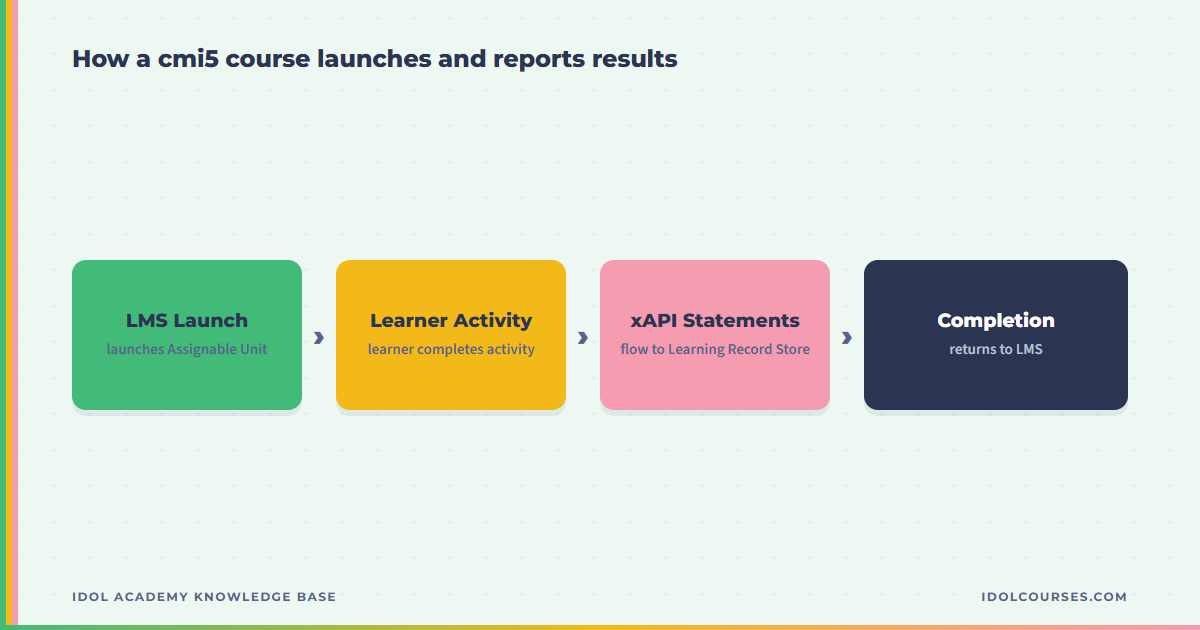
Here is the sequence, start to finish, in the order it happens.
1. You publish a package
Your authoring tool exports a zip file containing your content and a course structure XML file. That file describes the course as one or more Assignable Units. An AU is the smallest chunk the LMS can launch and track by itself, which makes it the cmi5 equivalent of a SCO in SCORM.
2. The LMS imports and assigns it
The LMS reads the structure file and now knows what the course contains. It can put it in a catalog, assign it to a group, and set a due date, exactly the way it would with a SCORM package. This is the administrative behavior xAPI alone never had.
3. The learner launches an AU
When someone opens the course, the LMS hands the content four things: the address of the Learning Record Store, a temporary authorization token, the learner's identity, and a registration identifier that ties this attempt together. That handoff is the part cmi5 standardizes and the part everyone used to build differently.
4. The content reports as it goes
The AU sends xAPI statements straight to the LRS. Some are required by the specification, including initialized and terminated. Others are yours to design. This is where an instructional designer earns the seat: deciding which learner behaviors are worth recording, because "everything" is not a strategy and produces a data set nobody reads.
5. Completion is settled, not guessed
Because the specification defines which statements count and how a mastery score is authorized, the LMS knows whether the learner passed without anyone writing custom logic. That is the whole point. Same package, same result, different vendors.
Do you need cmi5 to get hired?
No. And I want to be direct about that, because technical vocabulary is where career changers talk themselves out of applying.
Almost no instructional design job asks you to implement cmi5. That work usually belongs to an LMS administrator, a learning technologist, or a developer. What a hiring manager wants to know is whether you can hold a conversation with those people without slowing them down.
Here is the bar, and it is lower than you think. You should be able to say, in one or two sentences, what SCORM reports, what xAPI added, what an LRS holds, and why cmi5 connects them. If you can do that, you sound like a colleague who is new to the team rather than someone applying from outside the field.
The second thing that matters more than the vocabulary is judgment. Knowing that a mobile job aid used on a warehouse floor cannot be tracked with SCORM, and that the project therefore needs xAPI and somewhere to put the data, is a design decision. That is the conversation that gets you invited back. The U.S. Bureau of Labor Statistics groups instructional designers under training and development specialists and reports steady demand in that category, and the roles inside it increasingly expect people who can talk about measurement, not just production. You can review the occupational data at the BLS Occupational Outlook Handbook.
How to learn the technical stack without a computer science degree
Learn it in the order the field built it. That sequence makes each piece obvious instead of arbitrary.
- Start with the learning management system, because it is the container everything else plugs into.
- Then SCORM, because it is still what most of your first employers run.
- Then xAPI, so you understand what SCORM could never see.
- Then the Learning Record Store, because xAPI data has to live somewhere.
- Then cmi5, which is the piece that ties the first four together.
Then do the part that actually makes it stick. Open an authoring tool, build one short module, and publish it twice. Once to SCORM, once to cmi5. Open both packages and look at the files. Twenty minutes of that teaches you more than a week of reading specifications, and you finish with something you can put in your portfolio.
That is the whole method I teach. Do it messy, then look at what you made. It is not possible to improve what does not exist yet.
Inside IDOL Academy, this sits alongside the eLearning Developer milestone, where you build and publish real modules rather than reading about the standards that carry them. The program awards 16 Credly-verified badges across eight core milestones, five authoring tool badges, and three levels of AI training, and every milestone is graded against a published rubric. Tool training and badge credentials are included in tuition. Software licenses remain your responsibility.
Frequently asked questions
Is cmi5 replacing SCORM?
cmi5 is designed to replace SCORM eventually, but that has not happened yet. SCORM is still the default in most corporate learning management systems because it is old, universally supported, and it works. Expect both to run side by side for years. Learn SCORM first, then learn cmi5 as the direction the field is moving.
What is the difference between cmi5 and xAPI?
xAPI is the data format that records learning activity as statements. cmi5 is a set of rules for using xAPI inside a learning management system, covering how a course launches, how a session is tracked, and how completion gets reported. Every cmi5 course uses xAPI. Not every xAPI implementation follows cmi5.
Do instructional designers need to know cmi5?
You do not need to configure cmi5 to get hired as an instructional designer. You do need to know what it is, what problem it solves, and when a project would call for it. That level of fluency takes an afternoon and it keeps you credible in a technical conversation with an LMS administrator or a developer.
Can Articulate Storyline publish to cmi5?
Yes. Articulate Storyline and Rise both include a cmi5 publish option, as do several other authoring tools. Publishing is the easy part. The harder question is whether the receiving learning management system supports cmi5, because many older corporate systems still accept only SCORM packages.
What does AU mean in cmi5?
AU stands for Assignable Unit. It is the smallest piece of content a learning management system can launch and track on its own under cmi5, roughly equivalent to a SCO in SCORM. A cmi5 course is a structure of one or more AUs described in a course structure file.
Do you need a Learning Record Store to use cmi5?
Yes. cmi5 courses send xAPI statements, and those statements have to land in a Learning Record Store. Some modern learning management systems include an LRS. Older ones do not, which is one of the practical reasons cmi5 adoption has been slower than the specification's supporters hoped.
The short version
cmi5 gives xAPI the launch, session, and completion rules SCORM always had, which is what lets one package run inside a learning management system and still record what a learner actually did. You do not have to implement it. You do have to be able to explain it, and that is a much shorter climb than it looks from outside the field.
Want to see if instructional design is the right move for you?
IDOL Academy is a GNPEC-authorized 24-week program that combines 16 Credly-verified credentials, built-in AI training, and a real internship milestone, all at a price point below comparable bootcamps.
Try IDOL Academy Free