What Is GNPEC Authorization?
Jul 13, 2026
What Is GNPEC Authorization?
By Dr. Robin Sargent · Founder, IDOL Academy · 9 min read
Quick answer
GNPEC authorization is state-level approval granted by the Georgia Nonpublic Postsecondary Education Commission. It confirms that a vocational or certificate program has met Georgia's standards for curriculum, financial responsibility, and student protections. It is not the same as accreditation, but it is a meaningful signal that a program is legitimate and legally operating.
In this article
GNPEC authorization is the formal approval granted by the Georgia Nonpublic Postsecondary Education Commission that allows a nonpublic school to legally operate, collect tuition, and issue certificates or credentials in the state of Georgia. If a program has GNPEC authorization, it has passed a state review of its curriculum, its financial standing, and its policies for protecting students. If it hasn't, it's operating without that oversight, and that matters more than most people realize when they're shopping for a career program.
What GNPEC actually is and what it does
The Georgia Nonpublic Postsecondary Education Commission is a state agency. Its job is to regulate nonpublic postsecondary schools operating in Georgia. That covers vocational programs, certificate programs, and career schools that are not part of the public university system.
GNPEC was established to protect students. Before state-level authorization requirements existed, people paid real money for programs that had no accountability to anyone. No required disclosures. No standards for what was taught. No recourse if the school closed overnight. GNPEC changed that for Georgia.
Today, any nonpublic postsecondary school that enrolls students in Georgia, charges tuition, and grants a credential or certificate must be authorized by GNPEC or an applicable exemption must apply. The Commission maintains a public registry of authorized schools. You can look up any school by name.
GNPEC oversight includes:
- Review of the school's financial standing and stability
- Review of curriculum and program content
- Verification of qualified instructors
- Requirements for student enrollment agreements and refund policies
- Ongoing renewal and reporting requirements
- Student complaint procedures and recourse processes
Authorization is not a one-time rubber stamp. Schools must maintain compliance and renew, which means the oversight continues after the initial approval.
What the authorization process requires from a school
Getting GNPEC authorization is not easy. It requires a school to put its operations on paper, submit them for review, and demonstrate compliance with Georgia's standards before it can legally operate.
The application process typically requires:
- Detailed program information: course outlines, learning objectives, instructional hours, and assessment methods
- Instructor qualifications: evidence that instructors have relevant credentials and experience
- Financial documentation: proof that the institution is financially stable enough to fulfill its obligations to enrolled students
- Student enrollment agreements: written contracts that disclose program costs, refund policies, and student rights
- Refund policy: a clear, documented policy that meets GNPEC requirements
- Student complaint procedures: a formal process for students to raise concerns
After initial authorization, schools must renew and continue meeting standards. If a school falls out of compliance, GNPEC can revoke authorization. That accountability is exactly what makes the designation meaningful.
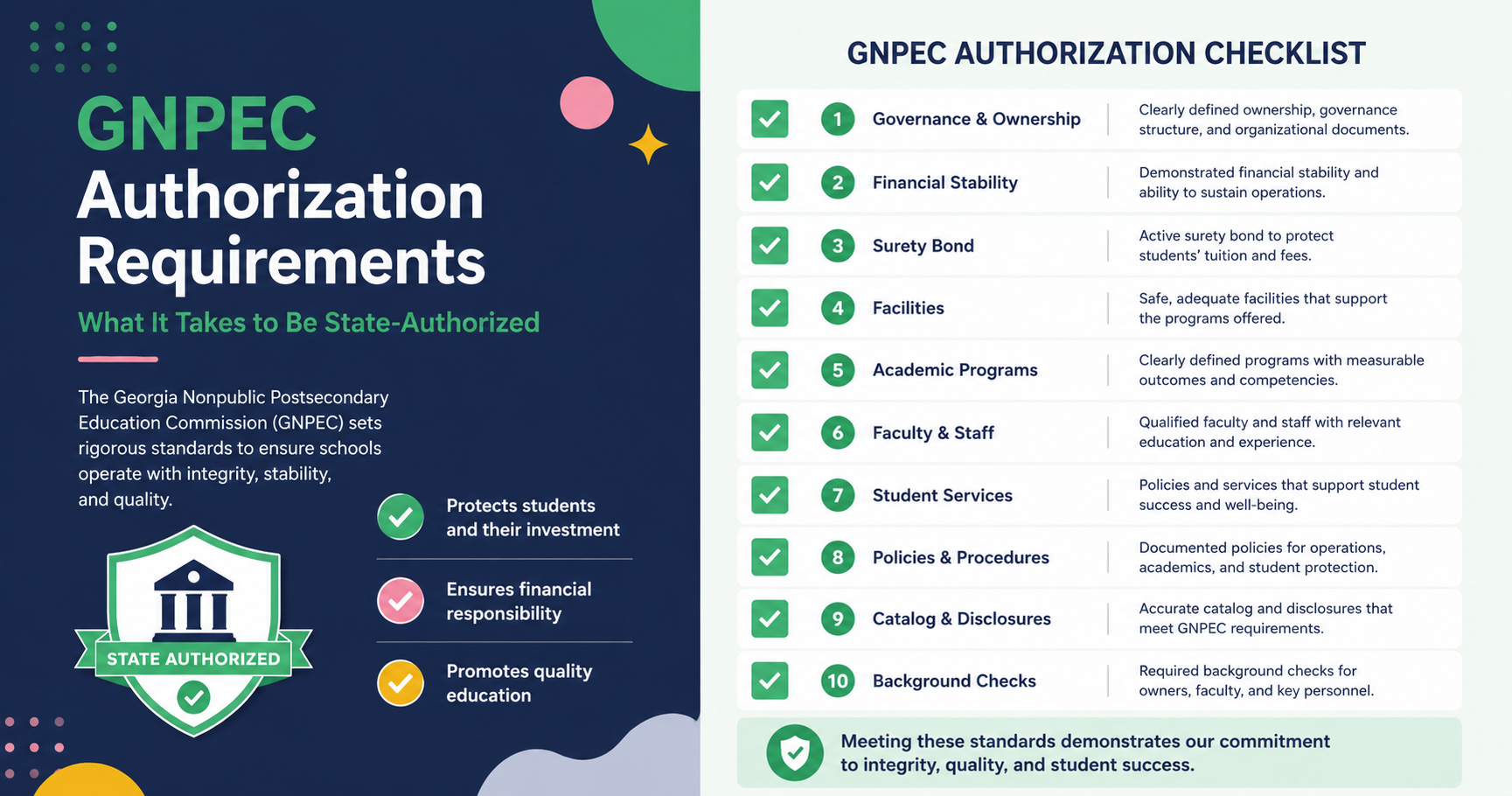 Key areas reviewed during the GNPEC authorization process
Ready to earn your CPTP and build a portfolio that proves it?
IDOL Academy is a GNPEC-authorized 24-week program that combines 16 Credly-verified credentials, built-in AI training, and a real internship milestone, all at a price point below comparable bootcamps.
Explore IDOL AcademyGNPEC authorization vs. accreditation: what's the real difference?
This is the question I hear most often when people are researching programs. They see "authorized" and they want to know if it means the same thing as "accredited." It does not. Here is exactly what each one means.
| Feature | GNPEC Authorization | Accreditation |
|---|---|---|
| Granted by | Georgia state government agency | Private accrediting body (e.g., SACSCOC, HLC) |
| Applies to | Vocational and certificate programs, nonpublic schools | Colleges and universities, often degree-granting |
| Primary purpose | Legal authorization to operate; consumer protection | Academic quality review; credit transferability |
| Enables federal financial aid? | Not by itself | Usually required for Title IV aid eligibility |
| Credential granted | Vocational certificate, professional credential | Degree (associate, bachelor's, master's, doctorate) |
| Oversight accountability | State of Georgia; public agency | Recognized private body; varies by accreditor |
| Public registry available? | Yes, at gnpec.georgia.gov | Yes, varies by accrediting body |
For a career certificate program in instructional design, GNPEC authorization is the relevant credential. You are not pursuing a degree. You are building a portfolio, earning industry-recognized badges, and getting the skills to land a job. A vocational certificate from a state-authorized program does that.
Accreditation matters most when you need your credits to transfer to another institution or when you are applying for federal student loans. If neither of those applies to your situation, what matters more is what you will be able to do and prove after you complete the program.
"Authorization is the floor. What you build on top of it is the career." — Dr. Robin Sargent
Why GNPEC authorization matters to you as a student
When you hand over tuition money, you deserve accountability. GNPEC authorization creates that accountability at the state level. Here is what it means practically for you as someone considering a vocational certificate program.
You have recourse if something goes wrong
GNPEC requires authorized schools to have a student complaint process. If you have a dispute with the school and cannot resolve it internally, you can file a complaint with GNPEC. That option does not exist when you enroll in a program with no state oversight. You are simply on your own.
The curriculum has been reviewed
Authorization requires submitting curriculum for review. That does not mean GNPEC tells a school what to teach. It means the school had to document what it teaches, show that it is relevant to the credential being awarded, and put that on record. A program that skips this process has never had to justify its curriculum to anyone outside the organization.
The school has demonstrated financial stability
GNPEC reviews financial documentation as part of the authorization process. This matters because you are making a significant financial commitment. A school that cannot demonstrate financial stability is a risk. If it closes midway through your enrollment, you want protections in place.
Refund and enrollment policies must meet state standards
GNPEC-authorized schools must provide written enrollment agreements and refund policies that meet state requirements. You know in writing what you are agreeing to before you pay. That basic transparency is not guaranteed at non-authorized programs.
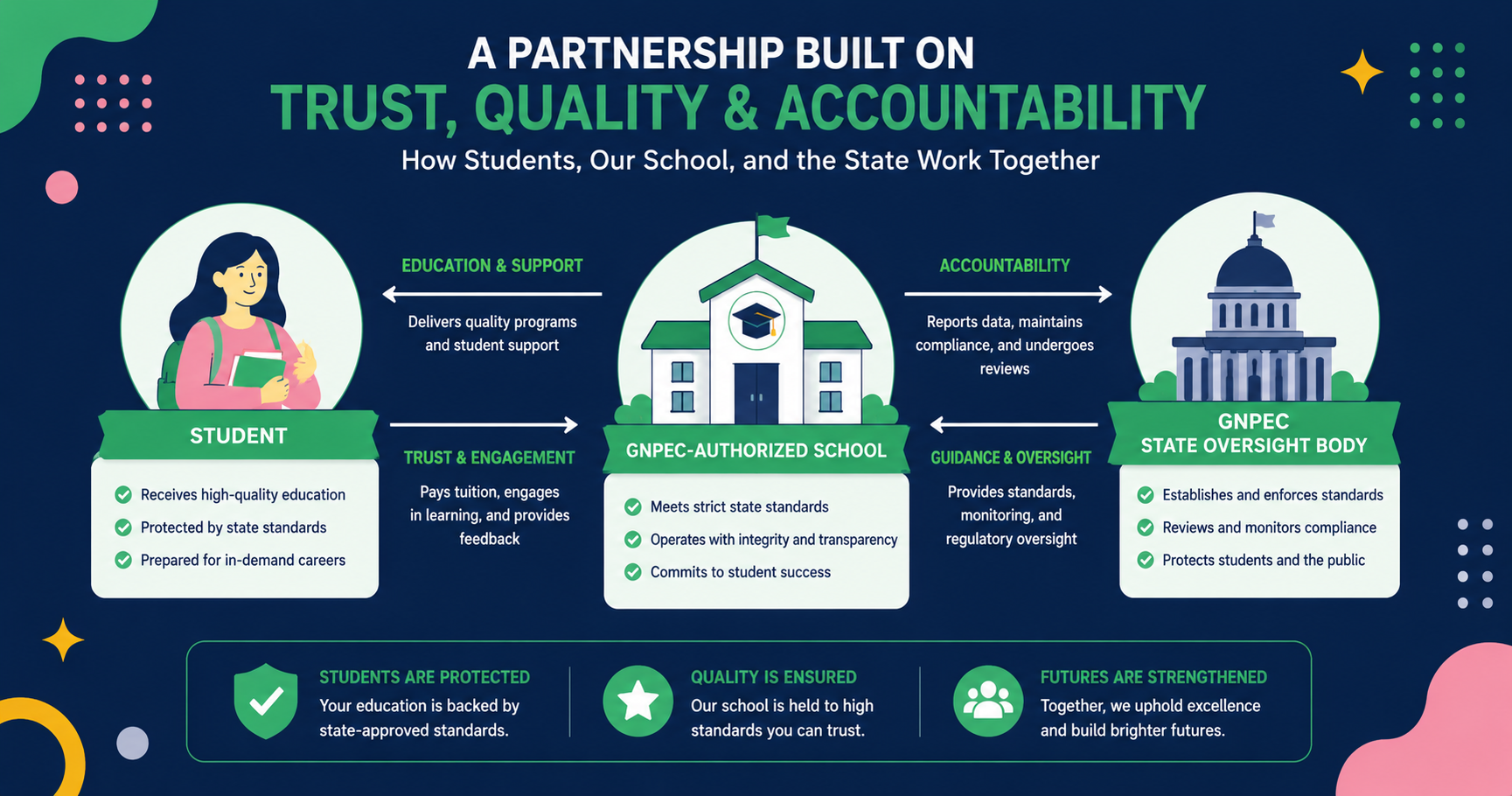 GNPEC authorization creates a chain of accountability that protects enrolled students
How IDOL Academy's GNPEC authorization fits in
IDOL Academy is authorized by the Georgia Nonpublic Postsecondary Education Commission. You can verify this yourself at gnpec.georgia.gov by searching the authorized schools registry.
What that authorization means for your enrollment:
- The 24-week curriculum has been submitted and reviewed by a state agency
- You receive a written enrollment agreement before paying
- The refund policy is documented and meets state requirements
- You have a formal student complaint process available to you
- The program's financial standing has been reviewed
IDOL Academy's authorization is one layer of credibility. The program also includes 16 Credly-verified badges across 8 core milestone badges, 5 tool badges, and 3 IDOLai AI certification badges. The capstone credential is the CPTP, Certified Professional in Training and Performance. Those credentials live in your Credly profile and are verifiable by any employer, anywhere. If you want to understand how the badge and credential system works alongside the authorization, the article on Credly and digital badges covers that in detail.
The authorization is not the reason people choose IDOL Academy. They choose it because of the portfolio they build, the credentials they earn, and the community they join. But the GNPEC authorization tells you that the foundation is solid. The school is accountable. You are not walking into something unregulated and hoping for the best.
For more context on how credentials, badges, and authorization all connect in a career pivot to instructional design, the IDOL Academy Knowledge Base covers each of these topics in depth.
Frequently Asked Questions
What does GNPEC stand for?
GNPEC stands for the Georgia Nonpublic Postsecondary Education Commission. It is the state agency in Georgia responsible for authorizing nonpublic postsecondary schools, including vocational certificate programs, to operate legally and collect tuition from students.
Is GNPEC authorization the same as accreditation?
No. Accreditation and GNPEC authorization are different things. Accreditation is granted by a private accrediting body and typically applies to degree-granting institutions. GNPEC authorization is a state-level legal authorization to operate as a nonpublic postsecondary school in Georgia. Both involve oversight, but they serve different purposes and carry different implications for students.
Why does GNPEC authorization matter when choosing a vocational program?
GNPEC authorization means the program has gone through a formal state review process covering its curriculum, financial stability, and student protection policies. Without it, a school is operating outside state oversight. For students, it signals that the program meets a baseline standard of legitimacy and is accountable to a public regulatory body.
Is IDOL Academy authorized by GNPEC?
Yes. IDOL Academy is authorized by the Georgia Nonpublic Postsecondary Education Commission (GNPEC). You can verify this directly on the GNPEC website at gnpec.georgia.gov, where authorized schools are listed in the public registry.
Do employers recognize GNPEC-authorized programs?
GNPEC authorization tells an employer that the program is state-regulated and legitimate, not an unvetted online course. Most hiring managers in instructional design focus on your portfolio, credentials, and demonstrated skills rather than the specific oversight body, but authorization does confirm the program is not a diploma mill or fly-by-night operation.
Can I verify a school's GNPEC authorization online?
Yes. The Georgia Nonpublic Postsecondary Education Commission maintains a public list of authorized schools on its website at gnpec.georgia.gov. You can search by school name to confirm current authorization status before you enroll anywhere.
GNPEC authorization is the state's way of saying a program is legitimate, accountable, and operating within established standards for student protection. If you are comparing programs and only one of them carries state authorization, that difference is worth weighing seriously.
Ready to earn your CPTP and build a portfolio that proves it?
IDOL Academy is a GNPEC-authorized 24-week program that combines 16 Credly-verified credentials, built-in AI training, and a real internship milestone, all at a price point below comparable bootcamps.
Explore IDOL Academy```