What Is the ADDIE Model? A Practical Guide for Instructional Designers
Jun 30, 2026
What Is the ADDIE Model? A Practical Guide for Instructional Designers
By Dr. Robin Sargent · Founder, IDOL Academy · Last updated: May 21, 2026 · 10 min read
Quick answer
What is the ADDIE model? It is the most widely used framework in instructional design, organized into five phases: Analysis, Design, Development, Implementation, and Evaluation. It gives designers a shared language and a repeatable process for building training that produces real results.
In this article
The ADDIE model is the most widely used framework in instructional design, and learning it is one of the first steps most career changers take. ADDIE stands for Analysis, Design, Development, Implementation, and Evaluation. It gives you a shared language and a repeatable process for turning a vague request for training into a course that actually changes how people perform.
What does ADDIE stand for?
ADDIE is an acronym. Each letter is one phase of the instructional design process, and each phase produces something the next phase needs:
- Analysis — Figure out what the real problem is, who the learners are, and whether training is even the right fix.
- Design — Decide what the training will teach, in what order, and how you will measure success. This is your blueprint.
- Development — Build the actual course: the slides, the eLearning module, the videos, the job aids, the assessments.
- Implementation — Deliver the training to learners and make sure the systems around it work.
- Evaluation — Find out whether it worked, then feed what you learned back into the process.
That is the whole model. Five plain words for five questions every training project has to answer. The power of ADDIE is not that it is clever. It is that it is shared. When a hiring manager, a project sponsor, and a designer all say "we are still in Analysis," they mean the same thing.
Where the ADDIE model came from
ADDIE was not invented in a marketing meeting. It grew out of military training development in the 1970s, where the cost of unclear instruction was high and a repeatable process was worth a lot. Over the following decades it was refined inside universities and adopted across corporate Learning and Development until it became the default way professionals describe their work.
Today, when the U.S. Bureau of Labor Statistics describes training and development specialists who "assess training needs, design programs, and evaluate effectiveness," it is describing the ADDIE phases without naming them. The model became the standard because it matched the job. Professional competency frameworks, including the standards published by IBSTPI, the International Board of Standards for Training, Performance and Instruction, map closely onto the same analyze, design, develop, evaluate cycle.
How each ADDIE phase works on a real project
The acronym is easy. Applying it is the actual skill. Here is how the five phases play out on a common project: a company asks you to build onboarding training for new hires.
Analysis
You do not start building. You start asking. Who are the new hires, and what do they already know? What should they be able to do after onboarding that they cannot do now? Is the real problem a skills gap, or is it a broken process that no course can fix? Analysis is where good designers earn their value, because it stops you from building a beautiful answer to the wrong question.
Design
Now you make the blueprint. You write clear, measurable learning objectives. You decide the sequence, the activities, and how you will assess whether learning happened. Nothing gets built yet. Design is planning on paper, and a strong blueprint makes Development far faster.
Development
This is the build. You create the eLearning module in a tool like Articulate Storyline, record the videos, write the job aids, and assemble the assessments. Development is the phase most beginners think of as the whole job. It is one phase of five.
Implementation
You launch. The course goes into the learning management system, learners get access, facilitators get briefed, and you confirm everything works the way it did on your screen. Implementation is where a good rollout plan keeps a strong course from failing on contact.
Evaluation
You ask the question that matters: did it work? Did new hires reach the objectives? Did performance change on the job? Evaluation is not the end of the line. What you learn here flows straight back into Analysis for the next version.
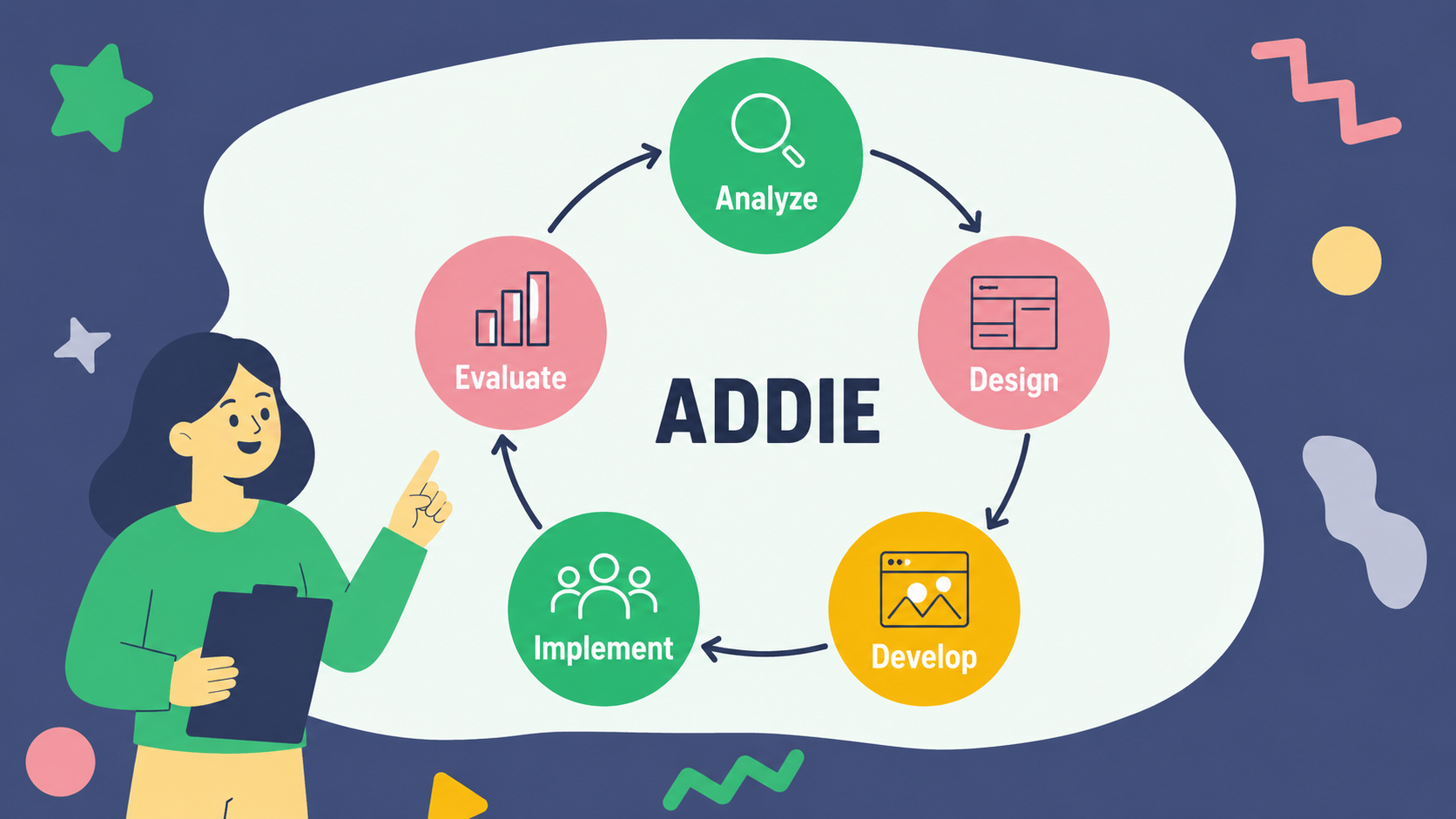 In real practice, ADDIE loops. Evaluation feeds the next round of Analysis and Design.
Want to see if instructional design is the right move for you?
IDOL Academy is a GNPEC-authorized 24-week program that combines 16 Credly-verified credentials, built-in AI training, and a real internship milestone, all at a price point below comparable bootcamps.
Try IDOL Academy FreeADDIE vs. SAM vs. the Do It Messy approach
ADDIE is not the only model you will hear about. Two others come up often, and understanding how they relate to ADDIE keeps you from thinking you have to pick a side.
| Approach | How it works | Best for |
|---|---|---|
| ADDIE | Five named phases. Often pictured as a sequence, applied as a loop. | Shared language, larger projects, and any team that needs clear stages. |
| SAM | Successive Approximation Model. Short repeated cycles of design, prototype, review. | Fast-moving projects where early feedback matters more than a fixed plan. |
| Do It Messy | A beginner-friendly mindset: use the phases, but build imperfect work early and improve it through feedback. | Career changers who need to start producing instead of over-planning. |
Here is the honest truth most beginners miss. These are not competitors. ADDIE gives you the vocabulary. SAM reminds you to iterate. The Do It Messy approach, developed by Dr. Robin Sargent across 17 years of designing corporate training, gives you permission to start before the plan is perfect. Strong designers borrow from all three.
Is the ADDIE model still relevant in 2026?
Yes. ADDIE is still the most common framework in corporate Learning and Development, and you will see its phases referenced in instructional design job postings. The criticism it gets is fair but specific: when ADDIE is treated as a strict waterfall, where you must fully finish Analysis before touching Design, projects get slow and rigid. Real learners and real business needs do not wait for that.
The fix is not to abandon ADDIE. It is to use it the way experienced designers always have, as a flexible cycle. Design thinking is non-linear. You will prototype during Development and discover something that sends you back to Design. You will run Evaluation and learn something that reshapes your next Analysis. The phases are real. The straight line was never the point.
"ADDIE will teach you the vocabulary of instructional design. It will not teach you the courage to ship before it is perfect. That part is on you." — Dr. Robin Sargent
Should you learn ADDIE as a career changer?
If you are moving into instructional design from teaching, training, HR, or an adjacent field, learn ADDIE early. It is the shared language of the industry, and a hiring manager will expect you to recognize the terms in an interview. The good news: if you have taught a class or built a training session, you have already done every ADDIE phase. You analyzed what your learners needed, designed a plan, developed materials, delivered them, and judged whether they worked. You just did not call it ADDIE.
What you should not do is study the model forever before you make anything. Knowing the five phases is worth an afternoon. Knowing how to run them on a real project is worth a career, and that only comes from doing the work. Build a blueprint. Get it reviewed against a real rubric. Build the next one better. That is how the framework moves from a definition you memorized to a skill you own. If you want a structured way to get there, start with what instructional design actually is and explore the full IDOL Academy Knowledge Base.
Frequently Asked Questions
What does ADDIE stand for?
ADDIE stands for Analysis, Design, Development, Implementation, and Evaluation. These are the five phases of the instructional design process. Each phase produces a specific output that feeds the next, from the initial needs analysis through to the final review of whether the training worked.
Is the ADDIE model still used in 2026?
Yes. ADDIE is still the most common framework in corporate Learning and Development, and most instructional design job postings expect familiarity with it. Modern teams apply it iteratively rather than as a strict step-by-step waterfall, looping back to earlier phases as they learn more.
What is the difference between ADDIE and SAM?
ADDIE is a five-phase framework often pictured as a sequence. SAM, the Successive Approximation Model, is built around short repeated cycles of design, prototype, and review. In practice the two overlap. Most experienced designers use ADDIE's vocabulary while working in the rapid, iterative way SAM describes.
Do you need to know ADDIE to become an instructional designer?
You should understand ADDIE because it is the shared language of the field, and hiring managers will expect you to recognize the terms. You do not need to memorize theory. You need to apply the phases to real projects and build a portfolio that shows you can.
Is ADDIE a linear or iterative process?
ADDIE is often drawn as a straight line, but real instructional design work is iterative. You routinely return to Analysis or Design after testing a prototype. Treating ADDIE as a flexible cycle rather than a one-way waterfall is how working designers actually use it.
How long does it take to learn the ADDIE model?
You can understand what the five ADDIE phases mean in an afternoon. Learning to apply them well takes practice on real projects. A structured program like IDOL Academy builds that practice into 24 weeks through milestone projects graded against a rubric.
The bottom line
The ADDIE model gives you the five phases and the shared language every instructional designer needs. What it cannot give you is the practice of running those phases on real work, and that practice is what gets you hired. IDOL Academy is a GNPEC-authorized 24-week program built to give you exactly that.
Want to see if instructional design is the right move for you?
IDOL Academy is a GNPEC-authorized 24-week program that combines 16 Credly-verified credentials, built-in AI training, and a real internship milestone, all at a price point below comparable bootcamps.
Try IDOL Academy Free