How the IDOL Milestone System Works
Oct 05, 2026
How the IDOL Milestone System Works
By Dr. Robin Sargent · Founder, IDOL Academy · Last updated: July 14, 2025 · 9 min read
Quick answer
The IDOL Academy milestone system divides the 24-week program into 8 sequential gates. Each milestone produces a real portfolio artifact, earns a Credly-verified badge, and unlocks the next phase. You can pay per milestone at $697 each or in full at $4,997.
In this article
- What is a milestone and why does this structure exist?
- What happens at each of the 8 milestones?
- How do Credly badges fit into the milestone system?
- How does the milestone payment structure work?
- What does the internship milestone look like in practice?
- How the milestone system compares to other program formats
- Frequently Asked Questions
The IDOL Academy milestone system is what makes the program work the way it does. Instead of dumping a full course library in your lap and wishing you luck, the program moves you through 8 sequential gates over 24 weeks. At each gate, you produce real work, earn a verified credential, and only then move forward. By the time you finish, you have a portfolio that proves you can do the job, not just a certificate that says you completed a course.
What is a milestone and why does this structure exist?
A milestone is a defined phase of the program with a clear output at the end. You complete the content, produce a deliverable, meet the standard for that phase, and earn a badge. Then the next milestone opens. That is the full loop.
I built the program this way because the alternative does not work. When you have unlimited access to a full course library with no gates, no deadlines, and no required output, most people stop before they finish. Life happens. The urgency disappears. You tell yourself you will get back to it. You do not.
The milestone structure creates a different dynamic. You are not binging content. You are working toward a specific, tangible outcome. Each milestone has a finish line you can see. That matters enormously for adults who are managing this program alongside a full-time job, a family, and everything else in their lives.
It also mirrors how real instructional design projects work. On the job, you do not design an entire course in one continuous sprint. You move through phases: analysis, design, development, review, revision, delivery. The milestone system trains you to think and work the same way before you ever land your first ID role.
What happens at each of the 8 milestones?
Each of the 8 milestones covers a distinct area of instructional design practice. You move through them in sequence because they build on each other. You cannot design a course before you understand what analysis produces. You cannot develop before you have a design document. The order is intentional.
Here is what each milestone produces:
- Milestone 1: Foundations of instructional design. You build your first portfolio artifact and establish the vocabulary and frameworks you will use throughout the program.
- Milestone 2: Needs analysis. You practice the skill that separates trained instructional designers from people who just make slides. You learn to identify whether training is actually the solution before you build anything.
- Milestone 3: Instructional design and curriculum development. You produce a full design document. This is the phase where tool training integrates directly into the work.
- Milestone 4: eLearning development. You build an actual eLearning module using industry-standard authoring tools. This is a portfolio piece you can show employers immediately.
- Milestone 5: Facilitator and job aids development. You produce instructor-led training materials and performance support tools. These are the deliverables corporate clients request most.
- Milestone 6: AI in instructional design via IDOLai. You complete the three AI certification levels built into the program: AI Beginner, AI User, and AI Creator. This is not a bonus add-on. It is a milestone gate.
- Milestone 7: Evaluation and measurement. You learn to demonstrate the business impact of training, the skill that gets instructional designers a seat at the table with leadership.
- Milestone 8: Internship. You apply your skills in a real-world context through one of four available pathways. More on this in its own section below.
When all 8 milestones are complete, you earn the CPTP: Certified Professional in Training and Performance. That is your program credential, issued through IDOL Academy and recognized on platforms like Credly where employers verify it.
Want to see if instructional design is the right move for you?
IDOL Academy is a GNPEC-authorized 24-week program that combines 16 Credly-verified credentials, built-in AI training, and a real internship milestone, all at a price point below comparable bootcamps.
Try IDOL Academy FreeHow do Credly badges fit into the milestone system?
Every time you complete a milestone, you earn a Credly-verified digital badge. That badge is a publicly shareable record of what you did and what you proved. It links back to the issuing organization, the date earned, and the criteria required to earn it. An employer can verify it in seconds.
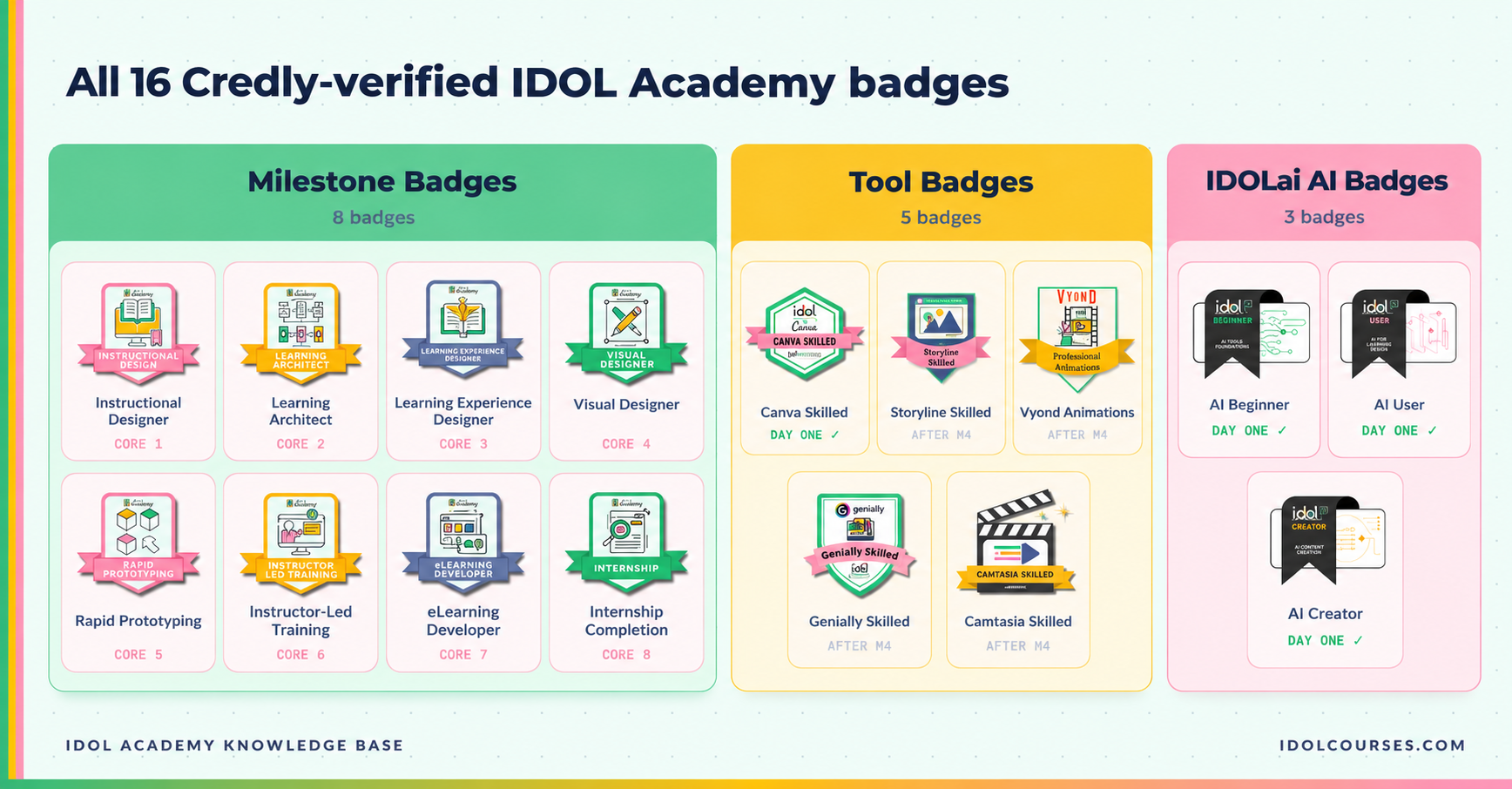
The full credential count across the program is 16 badges: 8 core milestone badges, 5 tool badges, and 3 AI badges through IDOLai. Most certificate programs give you one credential at the end. The milestone system gives you verifiable proof of progress at every stage, not just when you cross the finish line.
This matters practically. If you are job searching while still in the program, which a lot of IDOL learners do, you can share milestone badges on LinkedIn before you have the full CPTP. Hiring managers can see that you completed specific phases of a structured program and produced real deliverables in each one. That is a different kind of signal than "currently enrolled."
"A badge at the end of a course tells an employer you finished. A badge at every milestone tells them exactly what you can do and when you proved it." — Dr. Robin Sargent
The tool badges are earned separately within the relevant milestone phases by demonstrating actual proficiency in the software, not by watching a tutorial. The 3 IDOLai badges, AI Beginner, AI User, and AI Creator, are embedded in Milestone 6 and reflect a genuine progression of AI skill applied specifically to instructional design work.
How does the milestone payment structure work?
The milestone structure is not just an academic framework. It is also how the payment model is organized. You have two options:
| Payment Option | Cost | Best For |
|---|---|---|
| Pay-in-full | $4,997 | Learners who want immediate full access and the lowest total cost |
| Per-milestone | $697 per milestone × 8 | Learners who want to manage cash flow and evaluate value before continuing |
The per-milestone option is $5,576 total if you pay each one individually, so there is a real financial incentive to pay in full if you are committed. But the per-milestone path exists because I know many career changers are making this investment out of pocket while still paying a mortgage and supporting a family. Paying $697 to test the first milestone before committing to the full program is a reasonable way to reduce your risk.
Either way, the gate structure means you are always working toward the next specific checkpoint. You are not paying for access to a course library you may or may not use. You are paying for a phase of work you complete and a credential you earn.
For context on how this compares to the broader market: according to the U.S. Bureau of Labor Statistics, training and development specialists earned a median annual wage of $63,080 in 2023, with the top 10% earning over $100,000. The cost of the program, whether $4,997 or spread across milestones, is a fraction of the salary differential that a career move into instructional design can produce.
What does the internship milestone look like in practice?
Milestone 8 is the internship. It is also the milestone that people ask the most questions about, usually because they are worried it requires them to quit their current job or commit to an unpaid placement somewhere they have never heard of.
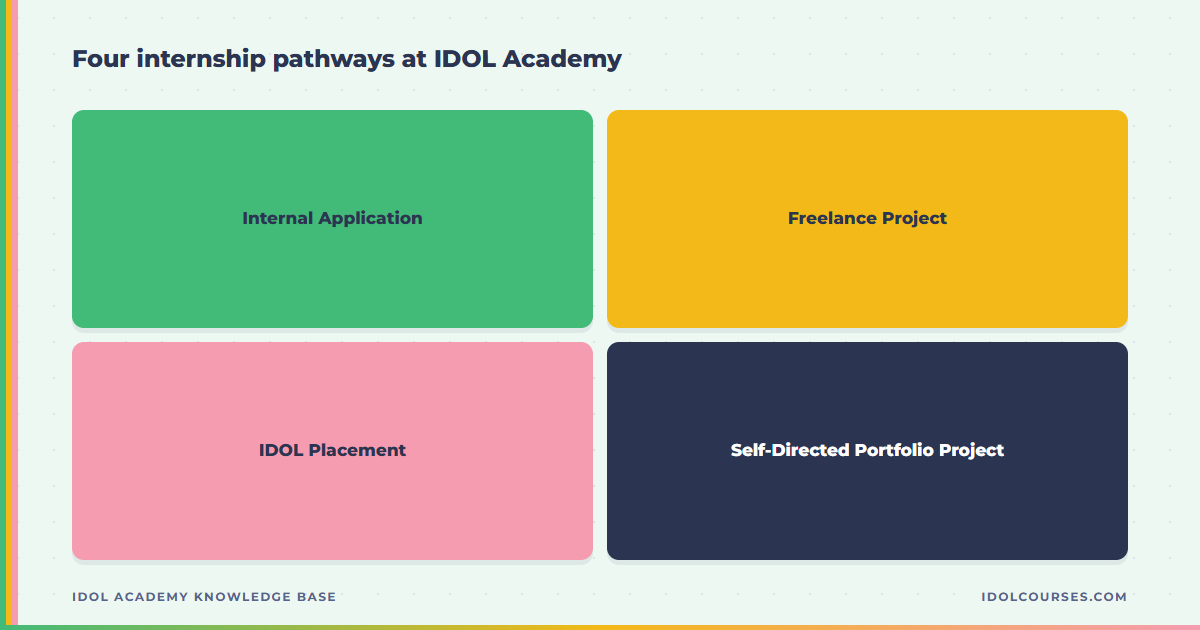
It does not. There are 4 internship pathways, and most learners complete this milestone without leaving their current role.
The four pathways give you options depending on where you are in your career transition:
- Internal application: You apply instructional design work within your current organization. If you are a teacher or trainer, you already have a context where real ID work needs doing. This pathway lets you get credit for doing it properly.
- Freelance project: You take on a paid or pro-bono ID project for an outside client. This path is common for people who have started building a freelance pipeline before finishing the program.
- IDOL internship placement: For learners who want a structured, facilitated experience with an IDOL-vetted organization or partner.
- Self-directed portfolio project: You design and develop a complete training solution from scratch using a real-world scenario. This results in a substantial, polished portfolio piece.
The goal of the internship milestone is the same as every other milestone: you produce something real. In this case, it is applied instructional design work in a context outside of a practice exercise. That distinction matters to employers. Anyone can complete a sandbox project. Fewer people can show they applied those skills to a real situation with actual constraints and stakeholders.
How the milestone system compares to other program formats
Not every instructional design program uses a milestone structure. Most fall into one of three formats: self-paced course libraries, cohort-based bootcamps, or traditional master's programs. Here is how those formats compare on the dimensions that matter most to career changers.
| Feature | IDOL Academy (Milestone) | Self-Paced Course Library | Master's Program |
|---|---|---|---|
| Duration | 24 weeks | Open-ended (varies widely) | 2 years typical |
| Portfolio output | Real artifacts at every milestone | Dependent on learner initiative | Thesis/capstone only |
| Credentials | 16 Credly-verified badges + CPTP | Completion certificate only | Master's degree |
| Completion accountability | Milestone gates enforce progress | Self-directed, low accountability | Academic deadlines and grades |
| Internship included | Yes, Milestone 8, 4 pathways | Rarely | Sometimes, varies by program |
| AI training included | Yes, 3 IDOLai levels in Milestone 6 | Rarely | Varies by program, often dated |
| Cost | $4,997 full or $697/milestone | $29-$500/month typically | $20,000-$60,000+ |
The comparison is not meant to dismiss any of these paths. A master's degree makes sense for some people. Self-paced libraries work for learners who already have strong self-direction and a clear goal. But if you are a career changer who needs a structured path, verifiable credentials, and a portfolio you can show employers in under two years, the milestone model is designed for exactly that.
For more on the broader program, the IDOL Academy Knowledge Base has detailed answers on everything from salary expectations to how the tool training works.
Frequently Asked Questions
How many milestones are in the IDOL Academy program?
There are 8 milestones in the IDOL Academy program. Each milestone is a sequential gate: you complete the work, earn a Credly-verified badge, and unlock the next phase. The full 24-week program includes 8 core milestone badges plus 5 tool badges and 3 AI badges through IDOLai.
Can I pay for IDOL Academy one milestone at a time?
Yes. You can pay $697 per milestone as you progress, or pay $4,997 upfront for the full program. The per-milestone option lets you manage your investment in stages and see the value of each phase before committing to the next.
What do I get when I complete a milestone?
When you complete a milestone, you earn a Credly-verified digital badge tied to that specific competency. You also add a portfolio piece built during that milestone to your instructional design portfolio. Both the badge and the portfolio artifact are shareable immediately on LinkedIn and with employers.
How long does each milestone take to complete?
The full 24-week program maps across 8 milestones, which works out to roughly 3 weeks per milestone. That said, the program is self-paced with milestone gates, so you move at your own speed. Most learners find they can progress without leaving their current job.
What is the difference between a milestone badge and a tool badge?
Milestone badges recognize the completion of a core program phase and the portfolio work that comes with it. Tool badges are earned by demonstrating proficiency in specific instructional design software. IDOL Academy includes 8 milestone badges and 5 tool badges, all verified through Credly.
Does IDOL Academy include an internship?
Yes. One of the 8 milestones is an internship milestone with 4 different pathways. Most learners complete this milestone without leaving their current job by applying instructional design work within their existing organization or through one of the other available pathways.
The IDOL Academy milestone system gives you a clear path through 24 weeks of real instructional design work, verified credentials at every stage, and a portfolio that proves you are ready before you ever send your first application. If you want to see what the first milestone looks like before you commit, the free trial is the right place to start.
Want to see if instructional design is the right move for you?
IDOL Academy is a GNPEC-authorized 24-week program that combines 16 Credly-verified credentials, built-in AI training, and a real internship milestone, all at a price point below comparable bootcamps.
Try IDOL Academy Free