Can You Become an Instructional Designer Without a Degree?
Jul 06, 2026
Can You Become an Instructional Designer Without a Degree?
By Dr. Robin Sargent · Founder, IDOL Academy · Last updated: July 14, 2025 · 9 min read
Quick answer
Yes. Entering instructional design without a degree is entirely possible and increasingly common. Corporate L&D employers hire based on portfolio quality, verified tool skills, and credentials, not diplomas. A structured certificate program that builds real work samples is the fastest credible path into the field.
In this article
- What employers actually look at when hiring instructional designers
- Degree vs. certificate vs. self-taught: what's the real difference?
- Which backgrounds transition most successfully into ID?
- What skills you actually need to get hired
- How to build a portfolio when you have no experience yet
- Frequently asked questions
Yes, you can pursue instructional design without a degree, and thousands of working instructional designers already have. This is not a loophole. It is how corporate learning and development hiring actually works. Employers care whether you can build effective training, navigate the tools, and show your thinking in a portfolio. A diploma from the right program helps. A diploma from an unrelated field that you got fifteen years ago does almost nothing.
What employers actually look at when hiring instructional designers
Pull up any mid-level instructional designer job posting from Google, Amazon, or Salesforce right now. You'll see the same things listed again and again: a portfolio of work samples, proficiency in Articulate Storyline or Rise, familiarity with adult learning principles, and ideally some experience working with subject matter experts. The degree requirement, when it appears at all, almost always reads "bachelor's degree in a related field, or equivalent experience."
That phrase, "or equivalent experience," is doing a lot of work. It means the hiring manager cares about what you can do, and a portfolio is the most direct proof of that. The U.S. Bureau of Labor Statistics categorizes instructional designers under training and development specialists, a field that projects 11% employment growth through 2033. That growth creates hiring pressure, and hiring pressure tends to make employers more flexible on credentials.
What employers are not flexible on: showing up to an interview without work samples. That is the real gatekeeping mechanism in this industry. Not your transcript.
"Your portfolio is your degree. Build it like your career depends on it, because it does." — Dr. Robin Sargent
Degree vs. certificate vs. self-taught: what's the real difference?
These are not equally valid options for everyone, and the differences matter. Here is an honest breakdown.
| Path | Time to job-ready | Typical cost | Portfolio included? | Best for |
|---|---|---|---|---|
| Master's degree in ID | 2–3 years | $20,000–$60,000+ | Sometimes | Academic roles, senior research positions |
| Bachelor's in a related field | 4 years | $40,000–$120,000+ | Rarely | Those just starting out with no other background |
| Vocational certificate (e.g., IDOL Academy) | 24 weeks | $4,997–$5,576 | Yes, built-in | Career changers who want to move fast |
| Self-taught (YouTube, free courses) | Unpredictable | Low to zero | No structure, you build your own | Highly self-directed learners with existing adjacent skills |
A master's degree in instructional design is genuinely useful for specific situations: higher education faculty roles, senior L&D leadership in large organizations, or research-focused positions. For most corporate ID roles, it is a two-year delay you cannot afford if you are trying to change careers now. The ROI just does not work out, especially when a focused certificate program can get you hired in six months.
The self-taught path is real but brutal. Without structure, most people get stuck in content consumption mode: they watch tutorials, read articles, take free courses, and never actually build anything. The portfolio stays empty. The job search stalls. Structure is what converts learning into output.
Want to see if instructional design is the right move for you?
IDOL Academy is a GNPEC-authorized 24-week program that combines 16 Credly-verified credentials, built-in AI training, and a real internship milestone, all at a price point below comparable bootcamps.
Try IDOL Academy FreeWhich backgrounds transition most successfully into ID?
Some backgrounds transfer so cleanly into instructional design that hiring managers actively seek them out. If you come from any of these fields, you are not starting from zero. You are starting with a significant advantage.
- K-12 and higher education teachers. You already understand learning objectives, differentiated instruction, formative assessment, and how to structure a lesson for different learner needs. The gap is tool proficiency and corporate context, both of which are learnable.
- Corporate trainers and facilitators. You know how adult learners behave in a room. You understand facilitation, learner engagement, and the difference between a training that lands and one that does not. Moving from facilitation to design is a natural evolution.
- HR professionals. You already work alongside training programs, understand compliance requirements, and interact with L&D teams. Adding design skills makes you considerably more valuable in your current role and opens adjacent career paths.
- Subject matter experts (SMEs). Engineers, healthcare professionals, financial services workers, and others who are deep experts in a field and want to turn their knowledge into training. Your content knowledge is rare and extremely marketable.
- Writers and content creators. Strong writing is foundational to good instructional design. If you can organize information clearly and write for a specific audience, you have a skill that many ID programs assume but do not teach.
What each of these backgrounds shares: they bring real-world experience that you cannot fake in a portfolio. When a former teacher designs onboarding training, you can see the pedagogical thinking in how they structure it. That is something a fresh graduate often cannot replicate.
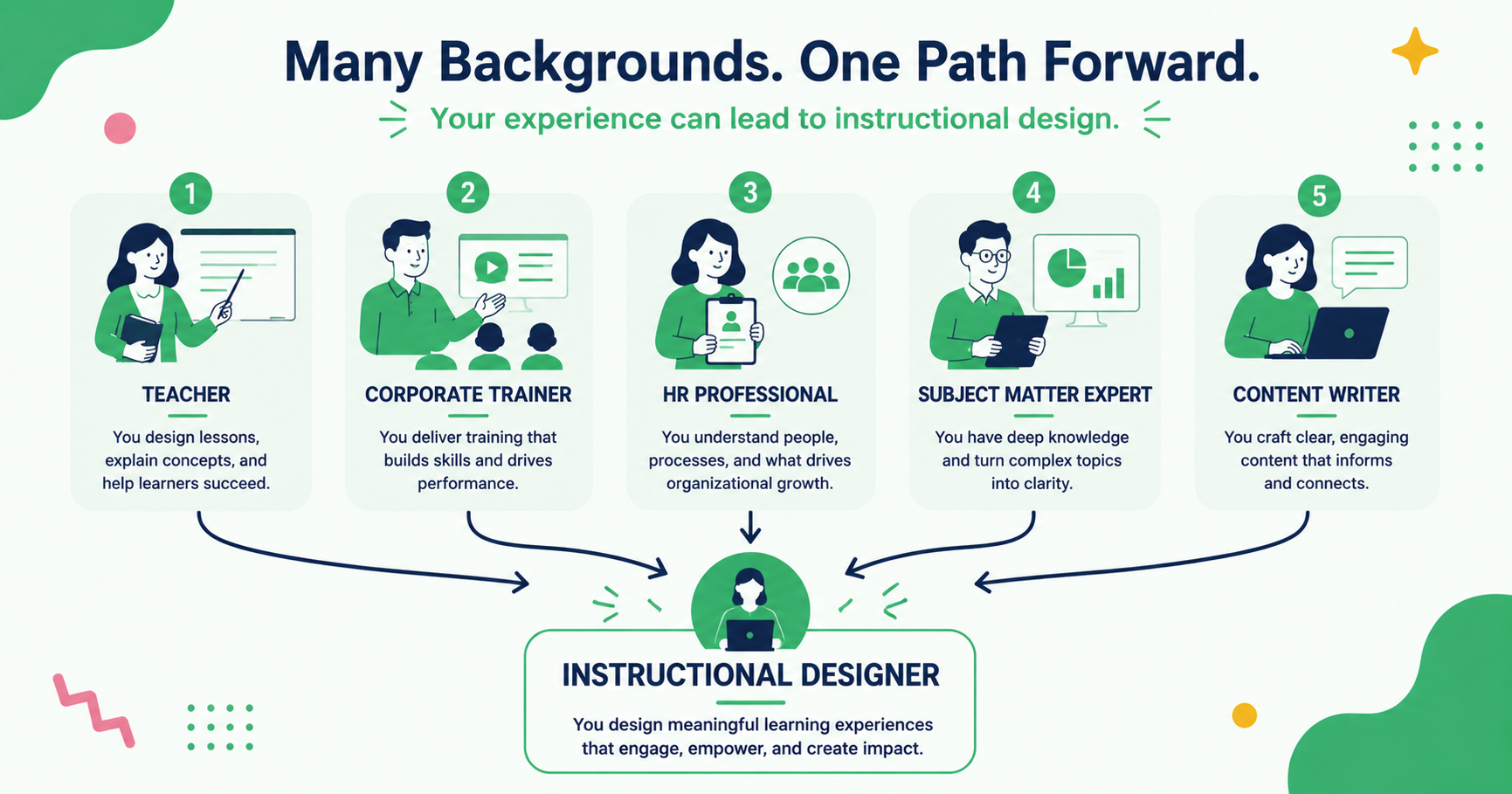 Common career backgrounds that transfer directly into instructional design roles.
What skills you actually need to get hired
A degree does not teach you these. Programs that lead to jobs do.
Authoring tool proficiency
Articulate Storyline and Articulate Rise dominate the market. Adobe Captivate is still present in some organizations. If you cannot demonstrate competence in at least one of these tools in your portfolio, you are not ready to apply. Knowing the theory of instructional design without being able to build in the tools is like knowing the theory of carpentry without being able to use a saw.
ADDIE or SAM process fluency
Employers want to know you understand how a project moves from needs analysis to evaluation. You do not need to have memorized every academic model. You need to be able to talk through your process clearly and show that your work samples reflect intentional design decisions, not just content dump formatted into slides.
Working with subject matter experts
Almost every ID role involves extracting information from SMEs who are busy, sometimes skeptical about training, and rarely aware of what instructional designers actually need from them. Knowing how to run a content extraction interview, manage feedback cycles, and deliver to scope is a practical skill that makes you immediately useful on day one.
AI fluency
This is no longer optional. L&D teams are using AI tools for content generation, voiceover, translation, and rapid prototyping at a pace that is reshaping project timelines. Candidates who can demonstrate AI-assisted design workflows are getting attention. IDOL Academy's IDOLai training covers three levels of AI proficiency and is built into the program tuition, not an add-on.
How to build a portfolio when you have no experience yet
This is the question that stops most career changers. "I cannot get a job without experience, and I cannot get experience without a job." It is a real problem. Here is how structured programs solve it.
The best certificate programs do not just teach you concepts. They give you projects. You design actual training modules, work through actual feedback cycles, and finish with actual deliverables you own. Those deliverables become your portfolio. That is the design philosophy behind IDOL Academy: every milestone produces work you can show an employer.
Beyond program projects, here are four ways to build portfolio samples before you land your first official ID role:
- Create spec work. Choose a topic you know well and design training for it as if you were hired to. A short eLearning module on fire safety, customer service, or compliance demonstrates exactly the same skills as a paid project.
- Volunteer for nonprofits or small businesses. Many small organizations need training materials and have zero budget for them. Offering your services in exchange for real project experience is a straightforward trade.
- Redesign something bad. Find a genuinely poor piece of training, a death-by-PowerPoint corporate module or an outdated PDF job aid, and redesign it. Showing a before-and-after with your reasoning is incredibly effective in an interview.
- Complete an internship pathway. IDOL Academy includes four internship pathway options, most of which you can complete without leaving your current job. Real-world experience documented in your portfolio is worth more than almost anything else you can add.
Three to five strong portfolio pieces will do more for your job search than any credential on its own. The credential signals that you completed a program. The portfolio proves that you actually learned something.
IDOL Academy graduates earn 16 Credly-verified badges across their 24 weeks: 8 core milestone badges, 5 tool-specific badges, and 3 AI proficiency badges through IDOLai. You can verify those badges on Credly, and so can any hiring manager. That combination of verifiable credentials plus a portfolio built through the program is what makes the difference for career changers entering this field without a traditional degree in ID.
For more on what the field looks like for people making this transition, the IDOL Academy Knowledge Base covers salary ranges, career pathways, and the daily reality of instructional design work in depth.
Frequently Asked Questions
Can you get a job in instructional design without a degree?
Yes. Many instructional designers working in corporate L&D today do not hold a degree specifically in instructional design. Employers prioritize a strong portfolio, demonstrated tool proficiency, and verifiable credentials over a specific diploma. A relevant certificate combined with real project samples is often more persuasive than an unrelated bachelor's degree.
What do employers actually look for when hiring instructional designers?
Most job postings ask for a portfolio of work samples, proficiency in authoring tools like Articulate Storyline or Rise, and some familiarity with adult learning principles. Verifiable credentials and certifications signal commitment and skill. A degree is often listed as preferred, not required, especially for candidates who can demonstrate results through their portfolio.
Is a certificate enough to break into instructional design?
A certificate alone is rarely enough. What makes a certificate valuable is what you produce during it: a portfolio of real projects, documented tool skills, and credentials that employers can verify. A program that builds your portfolio and earns you Credly-verified badges gives you tangible proof of skill, not just a completion document.
Do I need a master's degree in instructional design?
Not to get started. A master's degree in instructional design can be valuable for academic roles or senior positions at large organizations, but most entry- and mid-level corporate ID roles do not require one. The time and cost of a master's program (often two years and $20,000–$50,000+) is hard to justify when certificate programs can get you job-ready in months.
What is the fastest way to become an instructional designer without a degree?
The fastest credible path is a structured certificate program that teaches ID fundamentals, builds your portfolio with real projects, trains you on industry-standard tools, and provides verifiable credentials. IDOL Academy does this in 24 weeks with 16 Credly-verified badges, built-in AI training through IDOLai, and four internship pathways to get you real-world experience.
Can teachers become instructional designers without going back to school?
Absolutely. Teachers are among the strongest candidates for instructional design roles because they already understand learning objectives, curriculum structure, and how people absorb information. The gap is usually in tool proficiency and corporate context, both of which a focused certificate program can fill without requiring a return to a traditional degree program.
Pursuing instructional design without a degree is not a workaround. It is a legitimate and well-worn path that thousands of working designers have already taken. Build the portfolio, earn the credentials, and you will be competing on the same field as anyone else.
Want to see if instructional design is the right move for you?
IDOL Academy is a GNPEC-authorized 24-week program that combines 16 Credly-verified credentials, built-in AI training, and a real internship milestone, all at a price point below comparable bootcamps.
Try IDOL Academy Free```