What Are Merrill's First Principles of Instruction?
Oct 05, 2026
What Are Merrill's First Principles of Instruction?
By Dr. Robin Sargent · Founder, IDOL Academy · Last updated: June 25, 2026 · 9 min read
Quick answer
Merrill's First Principles of instruction are five research-backed rules that make training actually work: task-centered, activation, demonstration, application, and integration. Anchor learning to a real problem, connect it to what people already know, show them how, let them practice with feedback, and help them carry the skill into their everyday work.
In this article
Merrill's First Principles of instruction are five conditions that have to be present for real learning to happen: task-centered, activation, demonstration, application, and integration. David Merrill found them by studying what the most effective instructional design models already had in common. They are not a process to follow. They are a quality check for whether your training will actually stick.
What are Merrill's First Principles, exactly?
Here's the thing most people get wrong. They think Merrill invented a new theory. He didn't. In 2002, M. David Merrill, professor emeritus of instructional technology at Utah State University, looked across a pile of existing instructional design models and theories and asked a simple question: what do the ones that actually work have in common? You can read his original paper, First Principles of Instruction, published in Educational Technology Research and Development. The answer he landed on was five recurring principles.
Think of them as the common denominator. ADDIE, the Pebble-in-the-Pond model, problem-based learning, and dozens of others all share these threads. Merrill named the threads. That's why they're called first principles. They sit underneath the models, not next to them.
The five principles, the way I teach them inside IDOL Academy, are task-centered, activation, demonstration, application, and integration. Some sources count task-centered as the hub that the other four orbit around. I teach all five together because in real work, you use all of them in the same blueprint.
The five principles, one by one
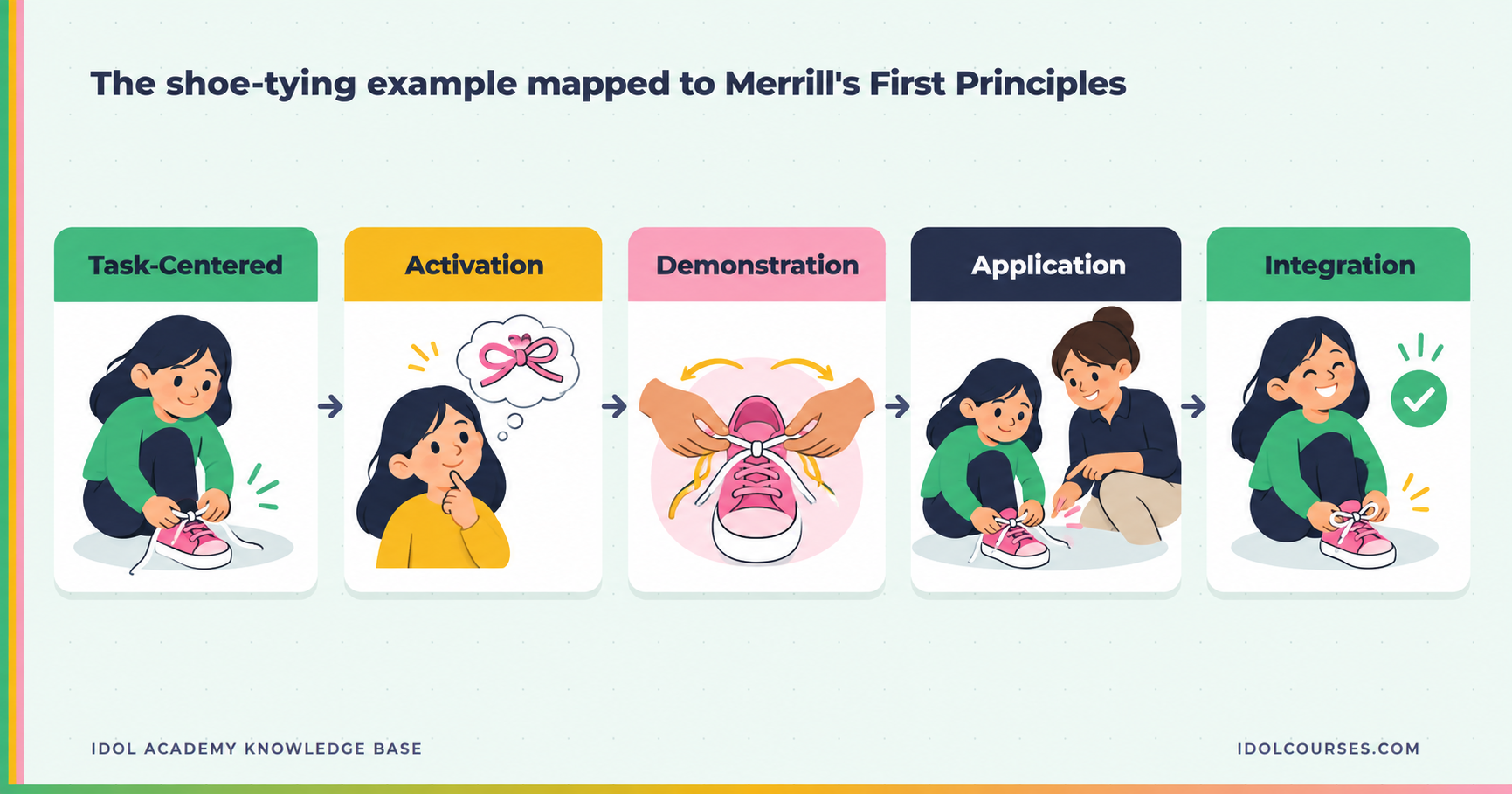
Let me walk you through each one. I'm going to use the same example I use with everyone who's new to this: teaching a kid to tie their shoes. It sounds small, but it has the exact same architecture as any corporate training you'll ever build.
1. Task-centered (or problem-centered)
Learning happens when it's anchored to a real task, not an abstract topic. You don't teach "the history of footwear fastening systems." You teach "tie this shoe so it doesn't come undone." Same with corporate work. You don't teach "an overview of our CRM." You teach "log a customer call so the next rep can pick it up." Start with the real job to be done. Everything else hangs off of it.
2. Activation
Learning happens when you connect new skills to what people already know. The kid already knows what a shoe is, what a knot is, what it feels like to trip on a loose lace. You activate that. In a workplace, your learner already has relevant experience. Surface it first. New information sticks to old information. With nothing to stick to, it slides right off.
3. Demonstration
Learning happens when you show people how it's done, not just tell them. You tie the shoe slowly while they watch. You don't hand them a paragraph describing the bunny-ear method and walk away. Demonstration means modeling the actual performance. Show the worked example. Show the finished product. Show the steps in motion. Telling is not showing, and showing is what teaches.
4. Application
Learning happens when people try it themselves and get feedback. The kid tries the knot with your hands hovering, ready to help. Then they try alone. You give feedback every time. In good ID, you build practice that starts easy and gets harder, with coaching along the way. This is the principle most courses skip, and it's the one that matters most. Reading about a skill is not the same as doing it.
5. Integration
Learning happens when people take the skill into their real world and make it their own. The kid ties their own shoes every morning without you, maybe even invents a faster way. In the workplace, integration means the learner uses the new skill on the job, adapts it, and teaches it to someone else. If the skill stays inside the course, you didn't finish the job. You parked it.
Why each principle matters in real ID work
When I started in instructional design back in 2012, no one handed me a guide. I learned the hard way that you can build a beautiful course full of polished slides and still teach no one anything. The principle I was missing, every time, was application. I was demonstrating like crazy and never letting people practice.
Here's why each one earns its place in your blueprint:
- Task-centered keeps you honest. If you can't name the real task, you're building a content dump, not training.
- Activation respects your learner's experience. This matters enormously for career changers and teachers, who already have transferable skills to build on.
- Demonstration is where most subject matter experts want to live. It's comfortable. It's also only the halfway point.
- Application is where learning actually gets built. It's the part stakeholders try to cut to save time. Protect it.
- Integration is how you prove the training mattered. Did behavior change on the job? That's the only score that counts.
Notice how naturally these line up with the way I teach the design process. You start messy, with a real problem. You prototype demonstrations and applications. You build multiple problem scenarios, easiest to hardest. You assess and revise. Merrill's principles and a problem-centered, do-it-messy approach are saying the same thing from two angles.
There's a reason these five hold up across so many models. Merrill anchored them in how people actually acquire skill, not in a fashionable theory of the moment. That's also why they survive the jump from a classroom to a corporate LMS to a 60-second microlearning clip. The format changes. The five conditions don't. When you internalize that, you stop chasing the newest authoring tool as if the tool were the point. The tool is never the point. The learning is the point, and the learning runs on these principles whether you build it in Storyline, in a live workshop, or on a napkin.
This is also why I tell people not to wait until they feel like experts. You learn these principles by using them on real work, badly at first, then better. It's not possible to improve what doesn't exist. Build the rough version, apply the principles, get feedback, and revise. Your skill grows ten times faster designing twenty imperfect blueprints than perfecting one.
"A course that only demonstrates is teaching about a skill. A course that lets people apply and integrate is teaching the skill. That gap is the whole job." — Dr. Robin Sargent
Want to see if instructional design is the right move for you?
IDOL Academy is a GNPEC-authorized 24-week program that combines 16 Credly-verified credentials, built-in AI training, and a real internship milestone, all at a price point below comparable bootcamps.
Try IDOL Academy FreeMerrill vs. a traditional content-dump course
The fastest way to understand Merrill's First Principles of instruction is to see what a course looks like with them and without them. Most bad training fails the same way: it stops after demonstration. Here's the side-by-side.
| Principle | Content-dump course | Merrill-aligned course |
|---|---|---|
| Task-centered | Organized by topic and chapter | Organized around a real task the learner must perform |
| Activation | Jumps straight into new content | Opens by surfacing what the learner already knows |
| Demonstration | Lists definitions and bullet points | Shows worked examples and the skill in action |
| Application | A final quiz on recall | Practice with feedback, easy to hard scenarios |
| Integration | Ends at the certificate | Builds in on-the-job use and a way to teach others |
People often ask how this is different from ADDIE. It's a fair question, and the answer is that they're not competitors. ADDIE is a process model. It tells you the phases to move through. Merrill's principles tell you what has to be true inside the learning for it to work. You can run ADDIE perfectly and still build the content-dump course on the left. If you want a refresher on the process side, read What Is the ADDIE Model? A Practical Guide for Instructional Designers. Use ADDIE for the workflow. Use Merrill to make sure the workflow produces something that teaches.
How to check if a course follows Merrill's First Principles
Here's a fast diagnostic you can run on any training, including one you built yourself. Walk through the five principles and ask one honest question for each. If you get a no, you found your weak spot.
- Task-centered: Can you name the exact real-world task the learner will be able to do at the end? If the answer is a topic instead of a task, you're topic-centered, not task-centered.
- Activation: Does the course open by connecting to something the learner already knows or has done? Or does it dump new content from the first screen?
- Demonstration: Does the learner actually see the skill performed, with a worked example? Or are they only reading definitions and bullet lists?
- Application: Does the learner get to practice the real skill and receive feedback? A multiple-choice recall quiz is not application. Practicing the actual task is.
- Integration: Is there a built-in way for the learner to use the skill on the job and make it their own? Or does the experience end at a certificate of completion?
In my experience, the two principles courses fail most often are application and integration. Both take more work to build than slides, so they're the first to get cut when a timeline tightens. Resist that. A course that only activates and demonstrates feels productive to make and teaches almost nothing. The skill lives in the practice and the transfer.
One more thing. You don't have to nail all five on the first pass. Spot the gap, fix the gap, ship the revision. That's the do-it-messy way, and it's also exactly how Merrill intended these principles to be used: as a practical lens for improving real instruction, not a rigid checklist to stall behind.
How IDOL Academy applies these principles
I'll be straight with you. When I built IDOL Academy, I didn't want to teach instructional design the way I was taught it, which was heavy on theory and light on doing. So the program is built on the same principles you just read. Not as a coincidence. On purpose.
- Task-centered: The 24-week program is organized around real projects and milestone gates, not lectures. You learn by building blueprints and courses, because learning is doing.
- Activation: If you're coming from teaching or training, the program starts by naming the skills you already have. You're closer than you think.
- Demonstration: You see worked examples, live lessons with replays, and guest practitioners showing how the work gets done in the field.
- Application: Every milestone is rubric-driven and reviewed by me personally. You practice, you get specific feedback, and you revise. That's the loop that builds skill.
- Integration: The internship milestone puts the skill into real work, with four pathways, most completable without leaving your current job. You finish with a portfolio that proves what a resume only claims.
That last point is the one I care about most. A portfolio of real projects is integration in action. It's proof you can do the work, which is exactly what hiring managers at companies like Google, Amazon, and Nike want to see. The credential matters. The proof matters more.
Frequently Asked Questions
What are Merrill's First Principles of instruction?
Merrill's First Principles of instruction are five research-backed conditions that make learning effective: task-centered (anchor learning to a real-world problem), activation (connect to prior knowledge), demonstration (show how it is done), application (let people practice with feedback), and integration (help people use the skill in their everyday work). David Merrill identified them by analyzing what the most effective instructional design models had in common.
Who created Merrill's First Principles of instruction?
M. David Merrill, a professor emeritus of instructional technology at Utah State University, published the First Principles of Instruction in 2002. He did not invent a brand-new theory. He reviewed many existing instructional design models and theories and pulled out the common principles that showed up in the ones that consistently worked.
How are Merrill's First Principles different from ADDIE?
ADDIE is a process model. It tells you the phases to move through: Analyze, Design, Develop, Implement, Evaluate. Merrill's First Principles are about the quality of the learning itself. They tell you what has to be true inside the course for people to actually learn. You can run ADDIE and still build a boring content dump. Merrill's principles are how you make sure the thing you build inside ADDIE works.
Is task-centered the same as problem-centered in Merrill's model?
Yes. Merrill uses the terms task-centered and problem-centered to describe the same central principle: learning should be anchored to a real-world task or problem, not to abstract topics. Some sources count it as the central principle that the other four orbit around, and some list it as one of the five. Either way, it means you start with a real job to be done.
How do I use Merrill's First Principles in a real course?
Start with a real task your learners need to perform. Open by connecting to what they already know. Demonstrate the skill with a real example, not just a definition. Give them a chance to practice and get feedback, moving from easy scenarios to harder ones. Finally, build in a way for them to apply the skill back in their own work. If a course skips application and integration, it is teaching about a skill instead of teaching the skill.
Does IDOL Academy teach Merrill's First Principles?
Yes. Merrill's First Principles are part of the foundation Dr. Robin Sargent teaches inside IDOL Academy, and the program itself is built on them. The 24-week structure is task-centered and milestone-driven, so you learn instructional design by designing real projects, getting feedback, and building a portfolio, which mirrors the application and integration principles directly.
Want to see if instructional design is the right move for you?
Merrill's First Principles work best when you practice them on real projects. IDOL Academy is a GNPEC-authorized 24-week program that combines 16 Credly-verified credentials, built-in AI training, and a real internship milestone, all at a price point below comparable bootcamps.
Try IDOL Academy Free