What Is Instructional Design?
Jun 24, 2026
What Is Instructional Design?
By Dr. Robin Sargent · Founder, IDOL Academy · 9 min read
Quick answer
Instructional design is the systematic process of creating learning experiences that produce real behavior change. Instructional designers analyze what people need to know, design the content structure, and build training that works across corporate, healthcare, tech, and government organizations.
In this article
Instructional design is the process of creating learning experiences that actually work. It combines learning science, project management, and content development to build training that changes what people know, do, or believe on the job. If you have ever wondered whether this could be your next career, you are in the right place. This article covers what the field is, what the work looks like day to day, where these jobs are, and how people make the transition.
What is instructional design, really?
The short version: instructional designers figure out what people need to learn and then build the thing that teaches it. That could be an online course, a video series, a job aid, a live workshop, or a blended program that combines several of those.
The longer version: instructional design is a discipline rooted in cognitive science, behavioral psychology, and systems thinking. It emerged from military training research in the mid-20th century and has been refined through decades of applied practice in education and the private sector. The foundational idea is simple. Effective learning does not happen by accident. It has to be designed.
Most people who end up in this field come from teaching, training, HR, communications, or subject-matter expertise in some domain. They already understand how to explain things. What instructional design adds is a framework: a way of thinking about the gap between what people currently know and what they need to know, and a set of methods for closing that gap efficiently.
The most widely used framework is ADDIE: Analyze, Design, Develop, Implement, Evaluate. You will also encounter SAM (Successive Approximation Model) and Agile ID approaches in corporate settings. These are not competing ideologies. They are different rhythms for the same underlying work.
"Effective learning doesn't happen by accident. It has to be designed." — Dr. Robin Sargent
What do instructional designers actually do?
The job title can vary. You might see "instructional designer," "learning experience designer," "e-learning developer," "curriculum developer," or "learning and development specialist." The underlying work overlaps significantly across all of them.
Here is what a working instructional designer's project typically involves:
- Needs analysis: Meeting with stakeholders to understand the performance problem and confirm that training is actually the right solution.
- Audience analysis: Researching who the learners are, what they already know, and what context they are working in.
- Learning objective writing: Defining specific, measurable outcomes for the course or program.
- Content collaboration: Working with subject matter experts (SMEs) to gather accurate information and translate it into learnable content.
- Storyboarding and scripting: Mapping out the flow of a course or video before building anything.
- Course development: Building the actual content in tools like Articulate Storyline, Articulate Rise, Adobe Captivate, or Vyond.
- Review cycles: Iterating based on stakeholder and SME feedback before publishing.
- Evaluation: Measuring whether the training achieved its objectives, using methods like Kirkpatrick's four levels.
The ratio of those activities shifts depending on where you work. At a small company, you might do all of it yourself. At a large organization, you might specialize in one phase. Both situations have value, especially early in your career.
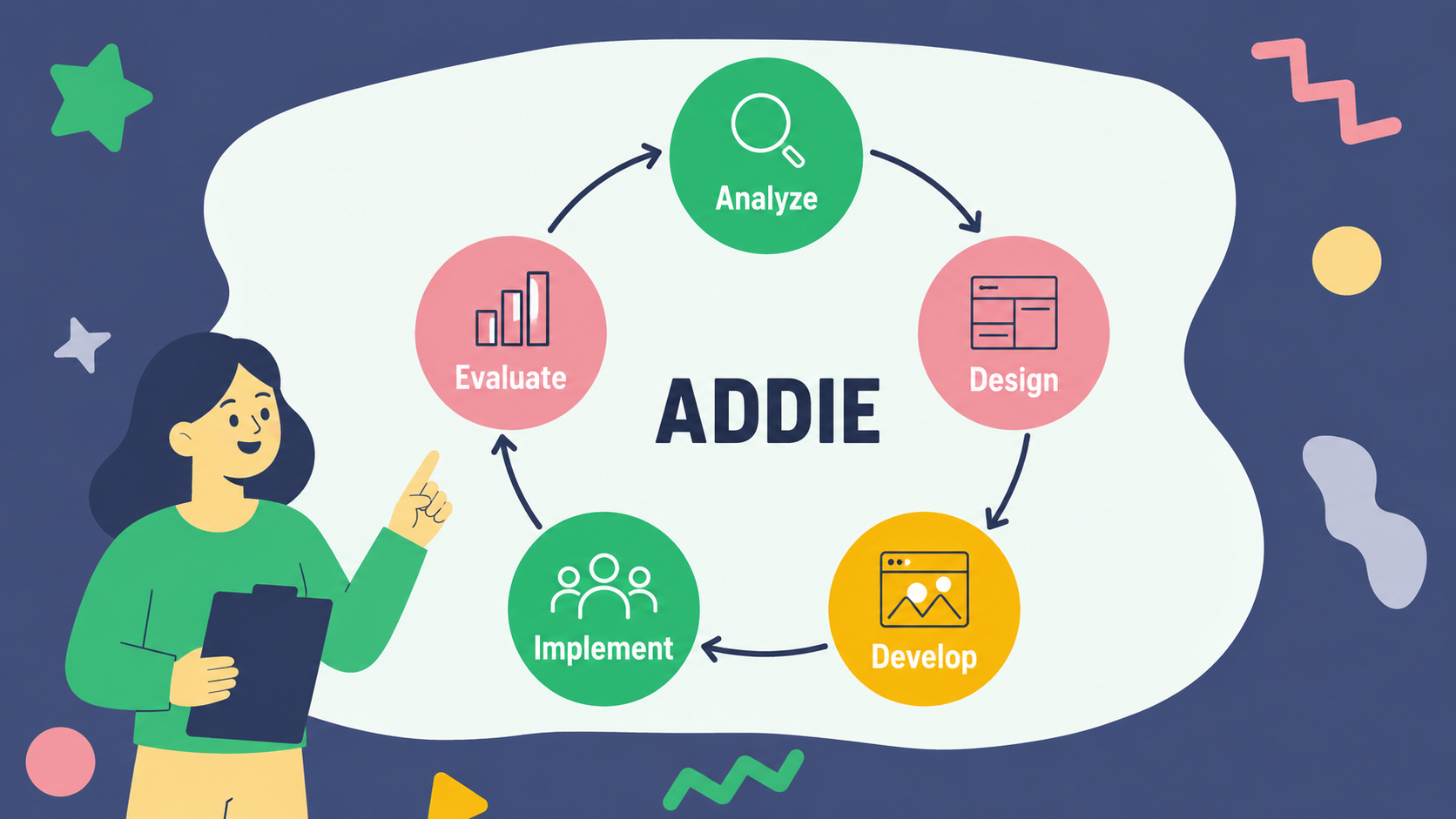 The ADDIE model is the most widely used framework in instructional design. Most corporate ID work follows some version of this process.
Where do instructional designers work?
This is one of the most common questions from people considering the field. The answer is: almost everywhere. Any organization large enough to have a learning and development function needs people who can design training. That includes:
- Technology companies: Google, Microsoft, Salesforce, and Amazon all hire instructional designers for internal employee training and for customer and partner education programs.
- Healthcare systems: Hospitals and health networks need ongoing clinical and compliance training, often with tight regulatory requirements.
- Financial services: Banks and insurance companies run continuous compliance and product training programs.
- Government and military: Federal agencies and branches of the armed forces have large, sophisticated L&D operations.
- Higher education: Universities hire instructional designers to support online and hybrid course development.
- Consulting and staffing firms: Companies like Deloitte, Accenture, and smaller boutique L&D agencies hire IDs for client projects.
- Nonprofits and associations: Many run member education and certification programs that need instructional design expertise.
According to the U.S. Bureau of Labor Statistics, the median annual wage for instructional coordinators was $77,970 as of May 2023, with the top 10 percent earning over $116,000. The field is projected to grow 2 percent through 2033, which tracks steady but not explosive demand. What the BLS numbers do not fully capture is how many instructional designers work under different titles or as independent contractors, both of which skew the total market larger.
Want the full program details before you decide?
IDOL Academy is a GNPEC-authorized 24-week program that combines 16 Credly-verified credentials, built-in AI training, and a real internship milestone, all at a price point below comparable bootcamps.
Download the BrochureHow does instructional design compare to related roles?
People researching this field often encounter a cluster of related job titles and get confused about how they differ. Here is a direct comparison.
| Role | Primary Focus | Typical Deliverables |
|---|---|---|
| Instructional Designer | Learning strategy and content architecture | Storyboards, scripts, course modules, job aids |
| E-Learning Developer | Building interactive content in authoring tools | Storyline or Rise courses, SCORM packages |
| L&D Specialist | Broader learning and development operations | Training programs, LMS administration, vendor management |
| Curriculum Developer | Structured program or course sequence design | Curriculum maps, lesson plans, assessment frameworks |
| Learning Experience Designer (LXD) | Learner-centered design with UX influence | Prototypes, journey maps, experience-first content |
| Training Specialist / Facilitator | Delivering training, not designing it | Live sessions, facilitation guides, participant materials |
In practice, many IDs do several of these things. Especially in smaller organizations or as freelancers, you wear multiple hats. The distinctions matter most at large companies where roles are specialized, and in those environments, having the language to describe your specific skills becomes important.
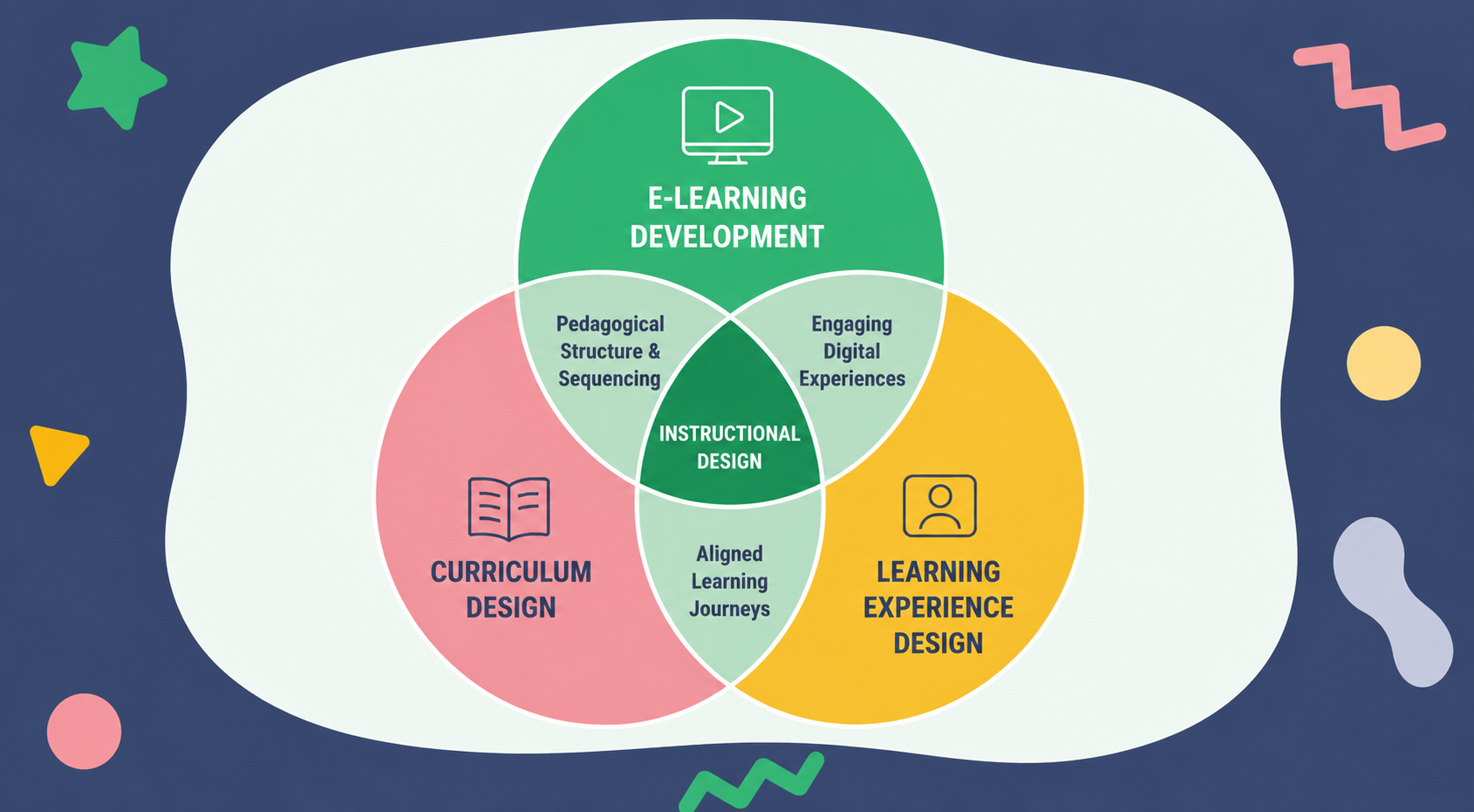 Instructional design sits at the center of several overlapping disciplines. Most working IDs draw from all of them.
How do you become an instructional designer?
There is no single required path. People enter this field from teaching, HR, communications, subject-matter expertise, and dozens of other starting points. What they share is a need to demonstrate two things: they understand how to design learning, and they have work to show for it.
Here are the most common pathways people take:
- Master's degree in instructional design or educational technology: A 2-year graduate program. Thorough, expensive, and time-intensive. Best for people who want to teach at the university level or move into senior leadership in large L&D organizations.
- Certificate programs: Shorter, focused programs that build applied skills and a portfolio. GNPEC-authorized programs like IDOL Academy are designed specifically for career changers who need to move quickly without a two-year commitment.
- Self-taught with portfolio: Some people piece together YouTube tutorials, free resources, and volunteer projects. It works, but it takes longer and the portfolio is harder to build without structure and feedback.
- Internal transition: If you are already working at a company with an L&D team, you may be able to volunteer for design projects and make a lateral move without leaving your employer.
Regardless of the path, your portfolio is what gets you hired. A hiring manager reviewing your resume will spend more time looking at your sample work than reading your education history. That means your goal is to have 3-5 strong portfolio pieces that demonstrate your ability to analyze, design, and develop real learning experiences.
The credentials you earn along the way matter too. IDOL Academy graduates complete 24 weeks of training and earn the Certified Professional in Training and Performance (CPTP) credential along with 16 Credly-verified digital badges, including 3 levels of AI training through IDOLai. Those credentials are verifiable on Credly and show up in recruiter searches. That is a practical advantage in a competitive hiring market.
If you want to read more about comparing your options, the IDOL Academy Knowledge Base covers the master's vs. certificate decision in detail, along with salary ranges, freelance considerations, and much more.
Frequently Asked Questions
What is instructional design in simple terms?
Instructional design is the process of creating learning experiences that change behavior or build skills. Instructional designers figure out what people need to learn, then build the courses, job aids, videos, or other materials that teach it in the most effective way possible.
What does an instructional designer actually do every day?
Day-to-day work varies by organization, but most instructional designers spend their time conducting needs analyses, collaborating with subject matter experts, writing scripts and storyboards, building content in tools like Articulate Storyline or Rise, and reviewing finished courses against learning objectives.
Is instructional design only for online courses?
No. Instructional design applies to any learning format: in-person workshops, job aids, video series, microlearning, onboarding programs, and live virtual training. The discipline is about the design of learning, not the delivery method.
Do you need a degree to become an instructional designer?
A specific degree is not required. Many working instructional designers came from teaching, HR, communications, or other fields. What employers want to see is a portfolio of real work and demonstrated knowledge of learning design principles. Authorized programs like IDOL Academy exist specifically for career changers.
How much do instructional designers make?
According to the U.S. Bureau of Labor Statistics, the median annual wage for instructional designers and coordinators was $77,970 as of May 2023. Senior designers and those at large tech or healthcare companies often earn well above that figure.
What is the difference between instructional design and e-learning development?
Instructional design is the strategy: analyzing needs, defining objectives, and structuring the learning experience. E-learning development is the execution: building that experience inside a tool like Articulate Storyline. Most instructional designers do both, but the design thinking comes first.
Instructional design is a field with a real career trajectory, strong salary potential, and genuinely interesting work. If you want the full picture on what IDOL Academy's 24-week program looks like before you commit to anything, the brochure is the best place to start.
Want the full program details before you decide?
IDOL Academy is a GNPEC-authorized 24-week program that combines 16 Credly-verified credentials, built-in AI training, and a real internship milestone, all at a price point below comparable bootcamps.
Download the Brochure```